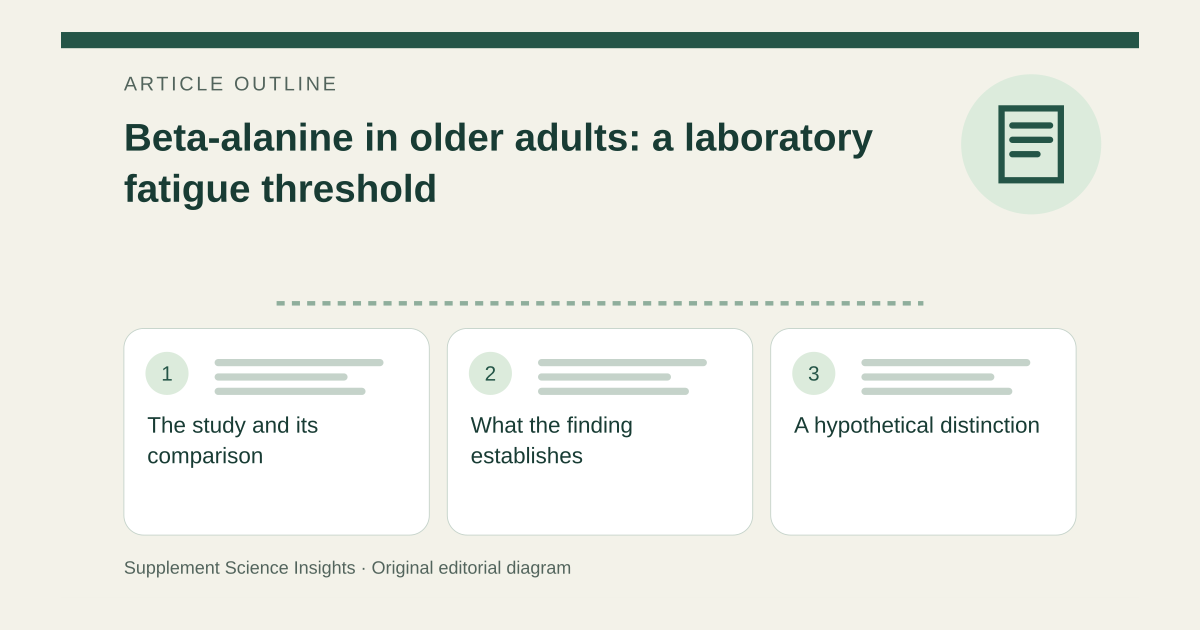
The study and its comparison
Twenty-six older men and women were randomized to beta-alanine 800 mg three times daily or placebo for ninety days. Cycling tests estimated the workload at a neuromuscular fatigue threshold. [1]
The abstract reported a 28.6-percent increase from baseline in the beta-alanine group and no change in the placebo group. It emphasized within-group changes rather than presenting a detailed between-group effect estimate. [1]
What the finding establishes
A significant change in one group and not the other is not itself a direct test of their difference. The small study does not establish fewer falls, greater independence or benefit from one pre-workout serving. Funding and conflicts were not established from the abstract. [1]
A hypothetical distinction
Imagine a cycling threshold rises. A claim about fewer falls would require a separate clinical endpoint.
| Detail | Interpretation |
|---|---|
| Measured outcome | Keep the endpoint specific |
| Study preparation | Not every retail product |
| Remaining uncertainty | Not resolved by a mechanism |
Sources for this article
- The effect of beta-alanine supplementation on neuromuscular fatigue in elderly (55-92 Years): a double-blind randomized study.
Source consulted: 2026-09-19. This is a reference resource, not a claim that we conducted the studies or tested a product.