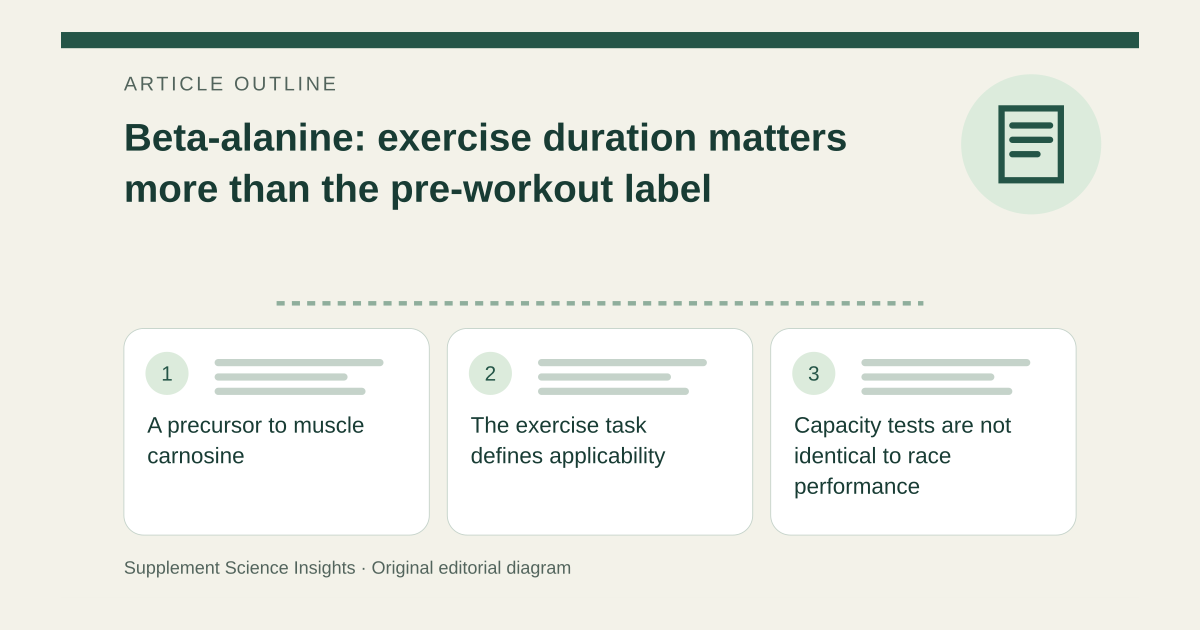
A precursor to muscle carnosine
Beta-alanine is an amino acid used to make carnosine, which helps buffer changes in muscle acidity during intense activity. It is different from the alanine used as a standard protein building block. Its specific biochemical role explains interest in certain exercise settings. [1]
Supplementation can raise muscle carnosine, but the size of that change varies. A biological response does not automatically establish the size of a performance improvement in a particular sport or person. [1]
The exercise task defines applicability
NIH ODS describes potential benefits in some short, high-intensity efforts, alongside inconsistent findings and differing expert interpretations. Results from a sustained hard effort or repeated exercise protocol should not be generalized to every endurance event or strength goal. [1]
The supplement has typically been studied over a period of use rather than simply as a sensation-producing ingredient immediately before a workout. A trial's duration, training status and test matter when interpreting its findings. [1]
Capacity tests are not identical to race performance
A time-to-exhaustion test asks how long someone continues at a fixed workload. A time trial asks how quickly they complete a defined amount of work. A percentage improvement in the first cannot simply be assigned to the second.
For resistance training, distinguish a single-session result from muscle or strength changes over weeks. A person completing more repetitions under one protocol has not necessarily demonstrated a larger long-term training adaptation. The study needs to measure the practical claim being made.
Tingling is an adverse effect, not an effectiveness score
Beta-alanine can cause transient tingling or prickling, known as paresthesia, and sometimes itching. The sensation should not be used as proof that a product is working or as a reason to increase exposure. [1]
Short studies have generally not identified major safety concerns at their tested amounts, but they do not establish indefinite safety for every population or blend. Multi-ingredient pre-workouts add separate considerations, including any stimulant exposure. This page does not provide a loading or dose-escalation schedule. [1]
Keep a capacity result in its own units
Imagine a fictional fixed-workload test increases from 200 to 220 seconds. That is 10 percent longer in that test. It does not predict a 10 percent faster race or a 10 percent increase in maximal strength.
An actual competition outcome would need direct measurement or a justified relationship to the test. The invented figures explain the denominator rather than an expected beta-alanine effect.
| Hypothetical result | Interpretation |
|---|---|
| 200 to 220 seconds | 10% longer fixed-workload capacity |
| Race time unmeasured | No equivalent speed claim |
| Tingling present | Not proof of benefit |
Match the supplement question to the sport
This overview does not recommend beta-alanine for every workout. A useful assessment identifies the intensity, duration, training context and meaningful endpoint. Muscle carnosine, tingling and competitive performance are separate observations and should remain separate in a product claim.
Sources for this article
- NIH ODS — Exercise and athletic performance: professional fact sheet
Source consulted: 2026-09-17. This is a reference resource, not a claim that we conducted the studies or tested a product.