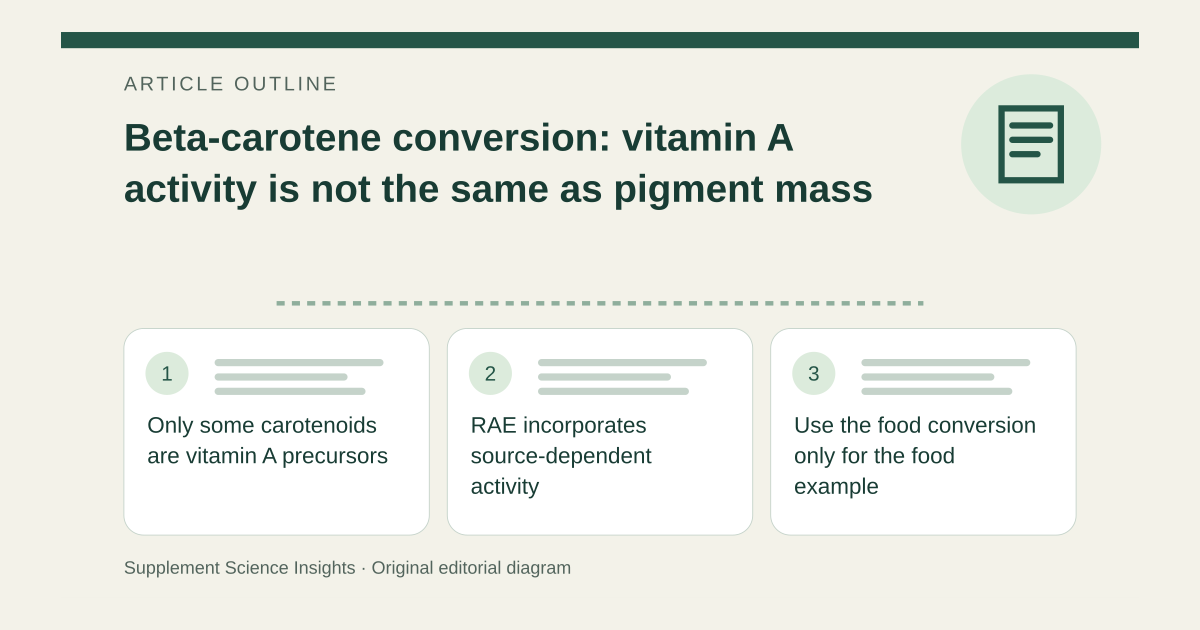
Only some carotenoids are vitamin A precursors
ODS describes intestinal conversion of provitamin A carotenoids through an enzyme pathway that includes BCMO1. Beta-carotene, alpha-carotene and beta-cryptoxanthin can contribute vitamin A; lutein, zeaxanthin and lycopene are not converted to vitamin A. [1]
Conversion efficiency can vary, including with genetic factors. The existence of that variation does not allow an individual conversion rate to be inferred from a food diary or a general genetic marketing claim. [1]
RAE incorporates source-dependent activity
ODS equates one microgram RAE with one microgram retinol, two micrograms supplemental beta-carotene or twelve micrograms beta-carotene from food. These are nutritional accounting relationships, not identical masses or a personal absorption test. [1]
The form also affects safety interpretation. The preformed vitamin A upper limit is not a blanket limit on carotenoid-rich vegetables, while high-dose beta-carotene supplements have separate adverse evidence in smokers and some other high-risk groups. [1]
Use the food conversion only for the food example
Imagine a food entry contains 1,200 micrograms of dietary beta-carotene. Dividing by twelve yields 100 micrograms RAE under the standard relationship. Applying that same divisor to supplemental beta-carotene would ignore the different source factor. Neither calculation measures individual enzyme activity.
| Entry | Meaning |
|---|---|
| 1,200 mcg dietary beta-carotene | Starting pigment amount |
| Divide by 12 | Food-source factor |
| 100 mcg RAE | Calculated vitamin A activity |
Sources for this article
- NIH ODS: Vitamin A and Carotenoids
Source consulted: 2026-09-17. This is a reference resource, not a claim that we conducted the studies or tested a product.