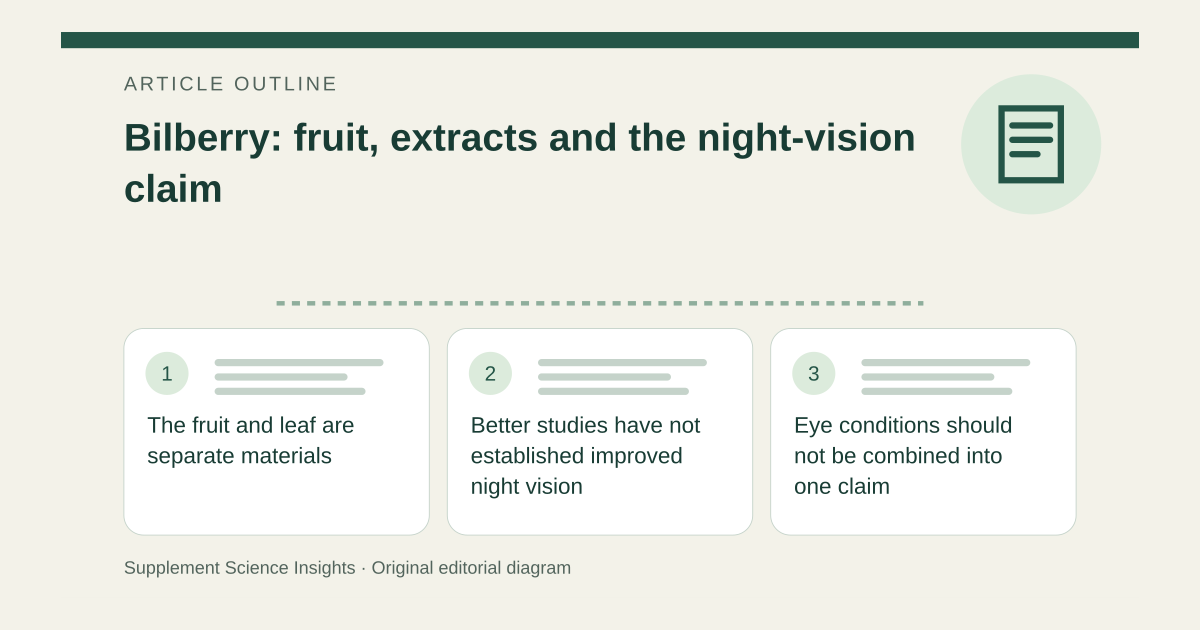
The fruit and leaf are separate materials
Bilberry is a Vaccinium species related to other familiar berries. Products may contain fruit, concentrated fruit extracts or leaf material. These should not be treated as one interchangeable ingredient simply because the plant name is shared. [1]
Fruit pigments, including anthocyanin-related compounds, are of research interest. Their presence establishes chemistry, not the size or even existence of a clinical benefit from a particular supplement. [1]
Better studies have not established improved night vision
NCCIH reports conflicting night-vision findings and notes that the more rigorous studies did not show benefit in healthy people. Evidence does not clearly establish bilberry for a health condition. [1]
A historical story about pilots or unusually sharp vision cannot substitute for a controlled trial. The relevant test would compare a defined preparation with an appropriate control using meaningful, prespecified visual outcomes. Repeating an attractive story does not make that comparison exist. [1]
Eye conditions should not be combined into one claim
Night vision, dry-eye symptoms, retinal disease and visual fatigue are different outcomes. Evidence about one does not establish treatment of the others. An ingredient's antioxidant activity cannot bridge those gaps by itself.
If a study concerns healthy volunteers, retain that population. If a commercial product contains several eye-health ingredients, keep the full formula in view. Neither a recognizable berry name nor a shared organ system makes two interventions equivalent.
Food use is not a leaf-extract safety assessment
Bilberry fruit is generally considered safe in normal food amounts, and some fruit extracts have been tolerated in limited studies. High-dose or prolonged leaf use may be unsafe. Safety information for supplemental amounts during pregnancy or breastfeeding is limited. [1]
People taking medicines should discuss the exact product with a clinician or pharmacist. Do not assume an evidence gap means there are no interactions, and do not interpret an uneventful short study as proof of indefinite safety. [1]
Compare a declared marker carefully
Imagine a fruit extract declares 100 mg per serving and 25 percent of a specified anthocyanin marker. That represents 25 mg of the declared marker. A 100 mg fruit powder without a marker declaration cannot be assigned the same amount.
Even matching percentages would not prove that the extracts are clinically interchangeable. The assay definition and preparation matter. This fictional exercise teaches how to preserve a label's meaning, not how to select a night-vision treatment.
| Fictional label | Marker quantity |
|---|---|
| 100 mg extract, specified marker 25% | 25 mg as declared |
| 100 mg fruit powder | Not established |
A vision concern deserves the right next step
New or worsening difficulty seeing at night needs an eye assessment. A supplement story cannot determine the cause. For a product claim, ask for the actual clinical comparison and outcome rather than treating fruit color as evidence of effectiveness. A fruit-extract finding should also retain the preparation's concentration and duration rather than being generalized to indefinite use of leaves.
Sources for this article
- NCCIH — Bilberry: Usefulness and Safety
Source consulted: 2026-09-17. This is a reference resource, not a claim that we conducted the studies or tested a product.