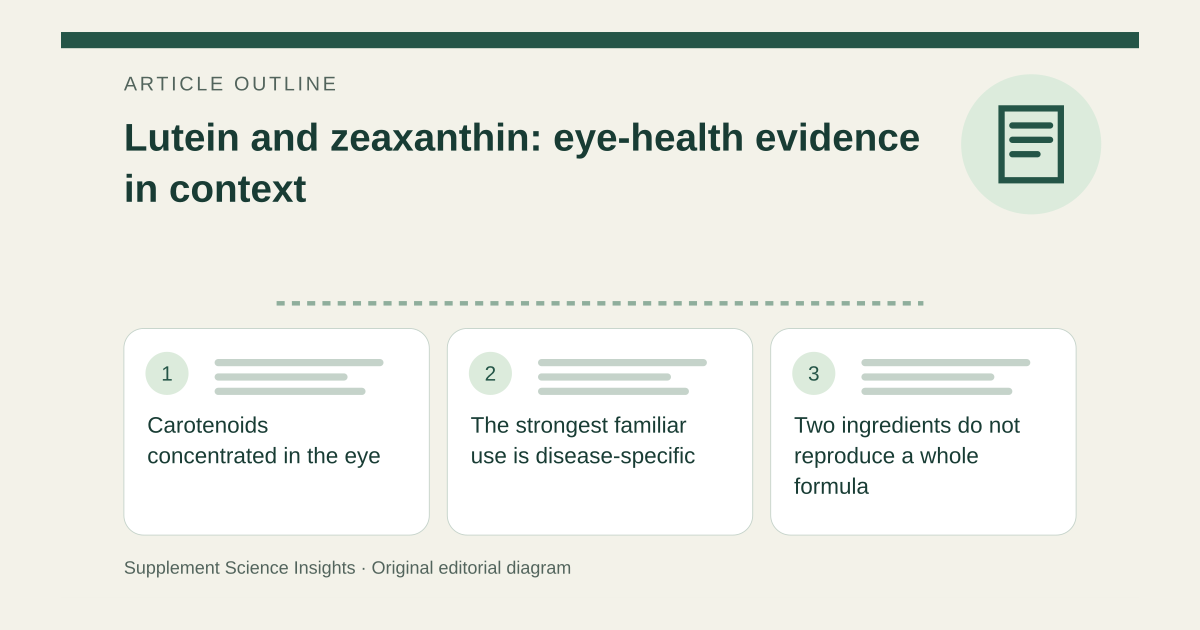
Carotenoids concentrated in the eye
Lutein and zeaxanthin are carotenoids found in foods and in parts of the eye, including the retina. Unlike beta-carotene, they are not converted to vitamin A. A product described as an eye-health carotenoid therefore need not be a source of vitamin A. [1]
Their presence in retinal tissue provides a biological reason to study them. It does not, by itself, prove that a supplement improves every kind of vision complaint, protects against ordinary screen use or replaces an eye examination. [1]
The strongest familiar use is disease-specific
The AREDS and AREDS2 studies examined supplement formulas in people at risk of progression of age-related macular degeneration. NEI explains that these formulas benefit selected disease stages and do not prevent AMD from beginning. Lutein and zeaxanthin replaced beta-carotene in the AREDS2 formulation. [1]
This is evidence about a formulation and a patient group, not a general instruction that everyone should take an eye supplement. The diagnosis and stage matter. A person with blurry vision cannot identify their eligibility by matching a symptom to a supplement advertisement. [1]
Two ingredients do not reproduce a whole formula
An AREDS2-style formula also contains other nutrients. A bottle containing only lutein and zeaxanthin is therefore not equivalent to the complete studied combination. NEI's patient guidance lists the components and recommends discussing suitability with an eye-care professional. [2]
The reverse mistake is possible too: a multi-ingredient product should not borrow the AREDS2 name solely because it contains these two carotenoids. Compare the complete formula, serving definition and actual amounts before treating a reference to the research as applicable. [2]
Check the rest of the formula
Older AREDS formulas contain beta-carotene, which is a concern for current and former smokers because of lung-cancer findings. Other components, including high-dose vitamin E and zinc, also belong in a medication and supplement review. A carotenoid-only headline can conceal those details. [2]
The appropriate question is not merely whether lutein sounds safe. It is whether the complete product fits the person's eye condition, medicines, smoking history and existing supplements. Bring the bottle or a clear label photograph to that discussion. [2]
Compare ingredients, not a combined headline
Imagine Product A declares 10 mg lutein and 2 mg zeaxanthin per serving. Product B declares a 12 mg “eye carotenoid blend” without individual amounts. The same total weight does not establish that B has A's composition.
Neither fictional label, by itself, establishes a full AREDS2 formulation. Record the separate quantities and all other ingredients, then compare them with the eye-care recommendation. The example explains disclosure; it does not recommend these quantities for a reader.
| Label | Separate quantities available? |
|---|---|
| A: lutein 10 mg, zeaxanthin 2 mg | Yes |
| B: 12 mg eye blend | No |
| Either label alone | Full AREDS2 formula not established |
Start with the eye-care question
If an ophthalmologist has recommended a formula, use that recommendation to define the comparison. If the concern is undiagnosed visual change, an ingredient list cannot identify its cause. These are different starting points and should lead to different next steps.
This overview summarizes NEI guidance and the limits of transferring trial results to products. It does not independently reanalyze AREDS2, assess every newer visual-performance trial or endorse a commercial brand.
Sources for this article
- National Eye Institute — AREDS/AREDS2 frequently asked questions
Source consulted: 2026-09-17. This is a reference resource, not a claim that we conducted the studies or tested a product. - National Eye Institute — AREDS2 supplements for AMD
Source consulted: 2026-09-17. This is a reference resource, not a claim that we conducted the studies or tested a product.