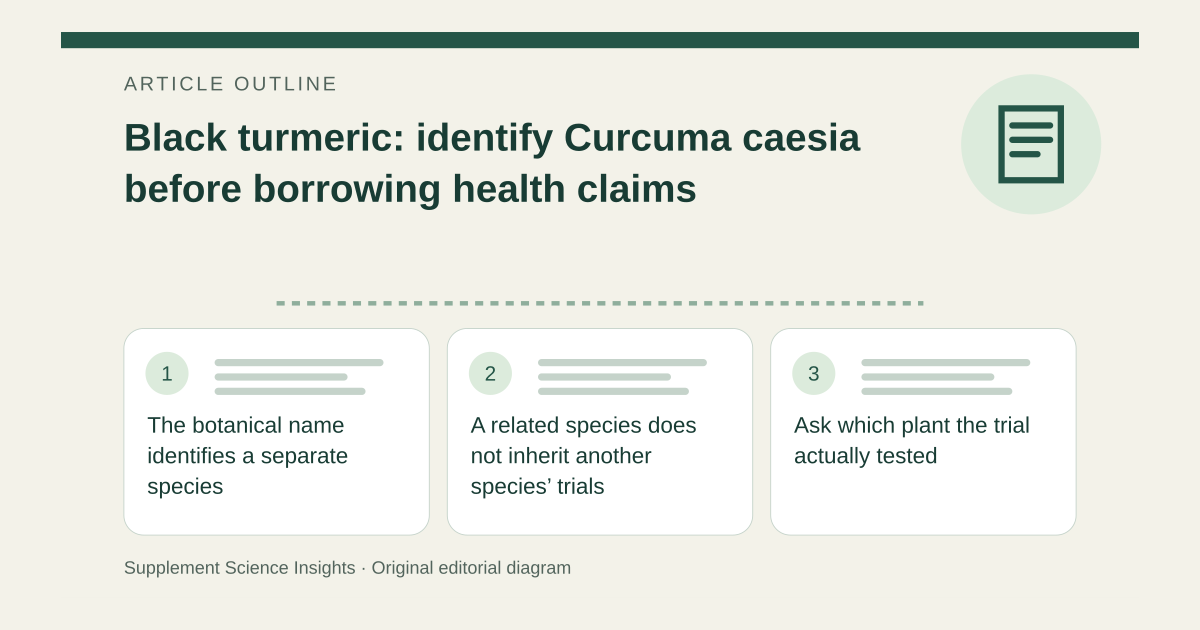
The botanical name identifies a separate species
The ICAR-AICRP spice list names black turmeric as Curcuma caesia. Kew recognizes C. caesia as an accepted species in the ginger family and describes it as a rhizomatous plant. [1][2][3]
This identity information is useful for interpreting a label. It does not establish a therapeutic dose or a clinical benefit for a commercial extract. [1][2][3]
A related species does not inherit another species’ trials
NCCIH’s turmeric discussion concerns Curcuma longa and its preparations. A seller citing that material for C. caesia still needs to justify the species and formulation match. [1][2][3]
The botanical sources cited here are not treatment trials. Traditional use, rarity or an unusual color should not be treated as evidence that black turmeric is stronger or more effective. [1][2][3]
Ask which plant the trial actually tested
Imagine a black-turmeric capsule cites a yellow-turmeric extract study. The shared genus is not enough to establish equivalent composition, exposure or outcomes.
| Detail | Interpretation |
|---|---|
| Black turmeric | C. caesia |
| Yellow turmeric research | Usually C. longa |
| Benefit transfer | Requires additional evidence |
Sources for this article
- ICAR-AICRP on Spices
Source consulted: 2026-09-18. This is a reference resource, not a claim that we conducted the studies or tested a product. - Curcuma caesia Roxb. | Plants of the World Online | Kew Science
Source consulted: 2026-09-18. This is a reference resource, not a claim that we conducted the studies or tested a product. - Turmeric: Usefulness and Safety | NCCIH
Source consulted: 2026-09-18. This is a reference resource, not a claim that we conducted the studies or tested a product.