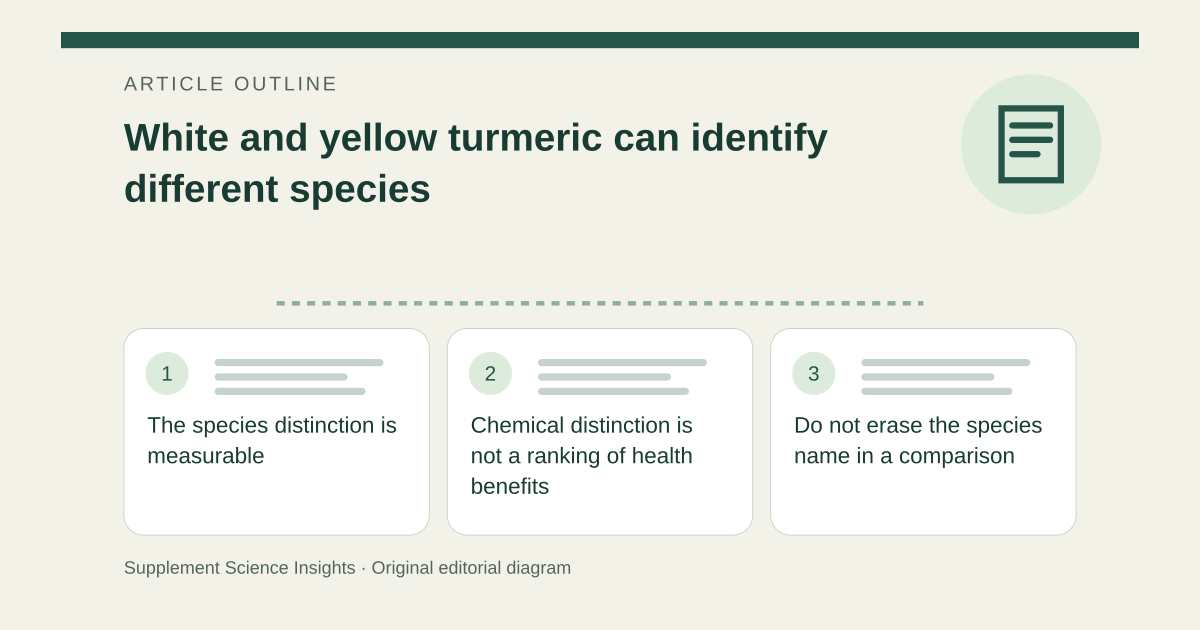
The species distinction is measurable
An analytical study explicitly distinguished yellow turmeric, Curcuma longa, from white turmeric, Curcuma zedoaria. It used infrared spectroscopy to detect mixtures of the two powders under tested laboratory conditions. [1][2]
That research shows why a precise identity matters. A color word alone is less informative than the scientific name, plant part and preparation. [1][2]
Chemical distinction is not a ranking of health benefits
The analytical study tested identification, not whether one species treats symptoms better than the other. Its detection results should not be converted into a clinical superiority claim. [1][2]
Likewise, findings for a Curcuma longa preparation do not automatically apply to a Curcuma zedoaria product. Match the actual species and formulation before borrowing an outcome claim. [1][2]
Do not erase the species name in a comparison
Imagine one study tested C. longa and a product lists C. zedoaria. Calling both turmeric leaves a material mismatch between the evidence and the product.
| Detail | Interpretation |
|---|---|
| C. longa | Yellow turmeric in the study |
| C. zedoaria | White turmeric in the study |
| Analytical detection | Not comparative clinical benefit |
Sources for this article
- Detection of Additives and Chemical Contaminants in Turmeric Powder Using FT-IR Spectroscopy - PubMed
Source consulted: 2026-09-18. This is a reference resource, not a claim that we conducted the studies or tested a product. - Turmeric: Usefulness and Safety | NCCIH
Source consulted: 2026-09-18. This is a reference resource, not a claim that we conducted the studies or tested a product.