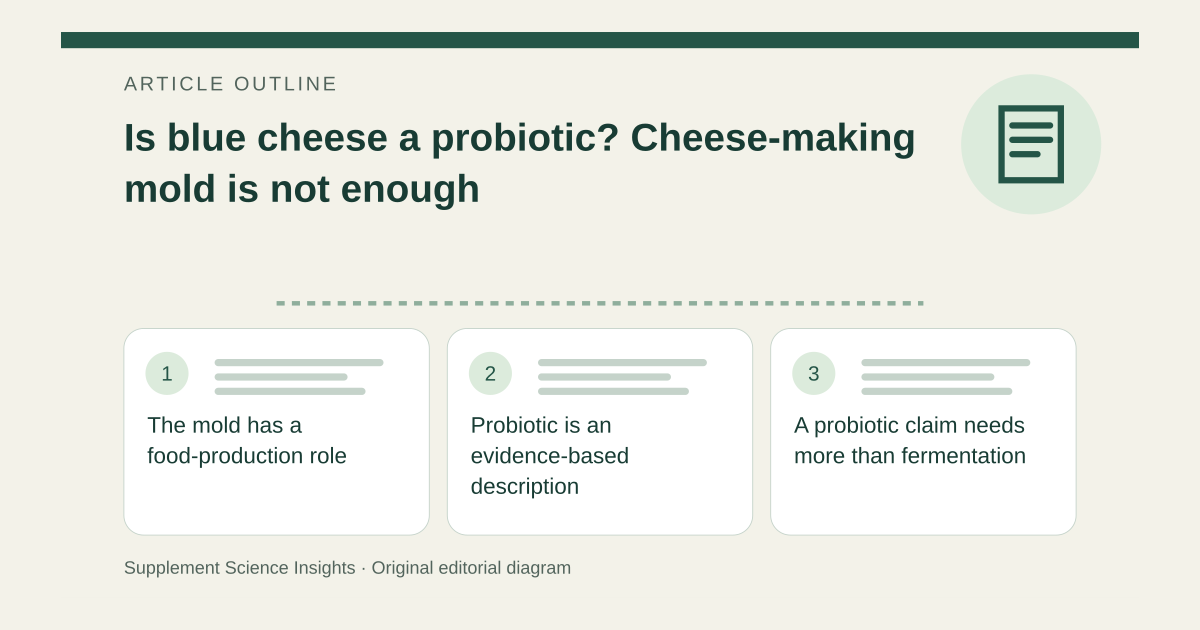
The mold has a food-production role
USDA describes Penicillium roqueforti use in blue-veined cheeses such as Roquefort, Gorgonzola and Stilton. Its intentional use during cheese production explains the characteristic product; it does not establish that any mold appearing on stored food is desirable or probiotic. [1]
Probiotic is an evidence-based description
ODS ties the term to live microorganisms, an adequate amount and a demonstrated health benefit. A cheese’s name or visible veins does not provide all those details. Do not transfer results from a named bacterial supplement to a mold-ripened food. [2]
A probiotic claim needs more than fermentation
Ask what organism and strain are present, whether a viable amount is documented and what outcome has been shown for that preparation. Without that information, describe blue cheese as a fermented food rather than assuming it is a treatment for gut symptoms. [2]
Separate culinary identity from a treatment decision
Imagine a package names a cheese-making culture but offers no clinical evidence. The culture helps identify how the food is produced. It does not tell a reader to replace an established treatment with the cheese or to eat a larger portion for a stronger probiotic effect. [1][2]
| Label detail | What it supports |
|---|---|
| Cheese-making culture named | Production identity |
| No strain-specific benefit evidence | No established treatment inference |
Sources for this article
- USDA FSIS: Are molds used to make cheese?
Source consulted: 2026-09-20. This is a reference resource, not a claim that we conducted the studies or tested a product. - Probiotics - Health Professional Fact Sheet
Source consulted: 2026-09-20. This is a reference resource, not a claim that we conducted the studies or tested a product.