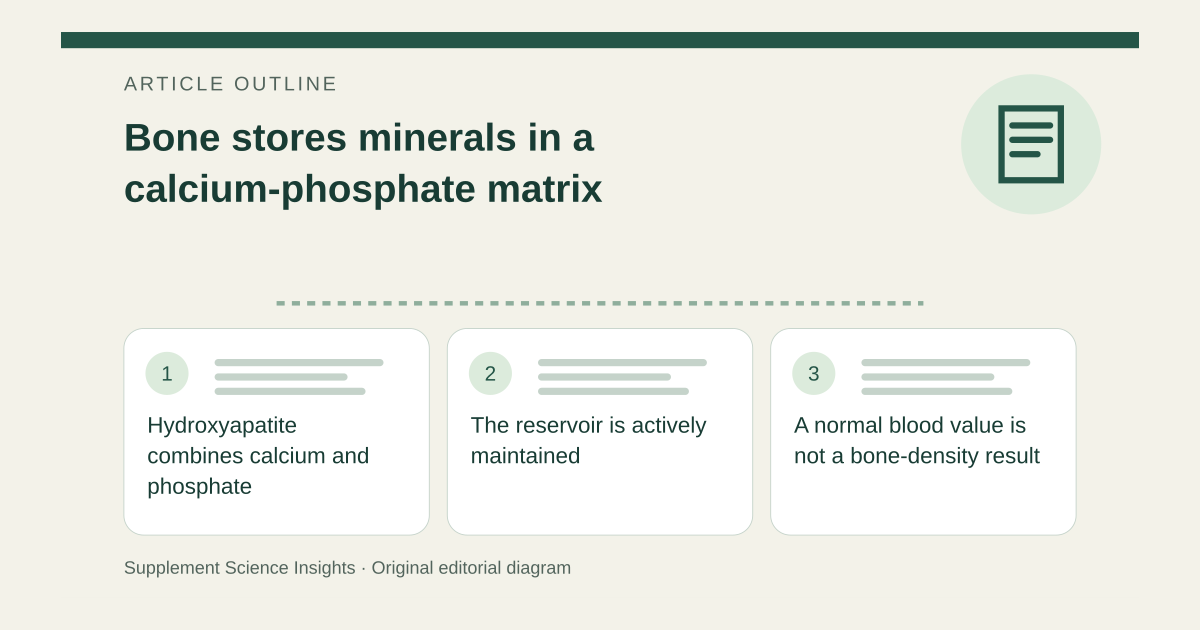
Hydroxyapatite combines calcium and phosphate
Bones also contain magnesium and zinc. NIH ODS estimates that roughly 50–60% of an adult’s magnesium is in bone and notes that most body zinc is in skeletal muscle and bone combined. These are different distributions: the zinc statement does not mean that most zinc is in bone alone, or that either element replaces calcium and phosphate as the main mineral framework. [1][2][3][4]
NIH ODS describes hydroxyapatite as an inorganic calcium-phosphate matrix in bones and teeth. It also notes that most body phosphorus is present in those mineralized tissues. [1][2][3][4]
Mineral is only part of bone’s structure. The fact that a mineral is stored there does not imply that consuming more of it indefinitely improves bone strength. [1][2][3][4]
The reservoir is actively maintained
Bone undergoes resorption and formation throughout life. ODS describes remodeling as important for growth, repair and maintaining calcium in the circulation. [1][2]
Consequently, a blood concentration is not a direct measurement of how much mineral the skeleton contains. Bone density, fracture risk and blood mineral regulation are related but different assessment questions. [1][2]
A normal blood value is not a bone-density result
Imagine someone interprets normal blood calcium as proof that bone density is normal. The regulated blood compartment does not provide that measurement.
| Detail | Interpretation |
|---|---|
| Calcium-phosphate matrix | Mineral component |
| Remodeling | Ongoing exchange |
| Blood result | Not a density scan |
Sources for this article
- Calcium - Health Professional Fact Sheet
Source consulted: 2026-09-18. This is a reference resource, not a claim that we conducted the studies or tested a product. - Phosphorus - Health Professional Fact Sheet
Source consulted: 2026-09-18. This is a reference resource, not a claim that we conducted the studies or tested a product. - NIH ODS — Magnesium
Source consulted: 2026-09-20. This is a reference resource, not a claim that we conducted the studies or tested a product. - NIH ODS — Zinc
Source consulted: 2026-09-20. This is a reference resource, not a claim that we conducted the studies or tested a product.