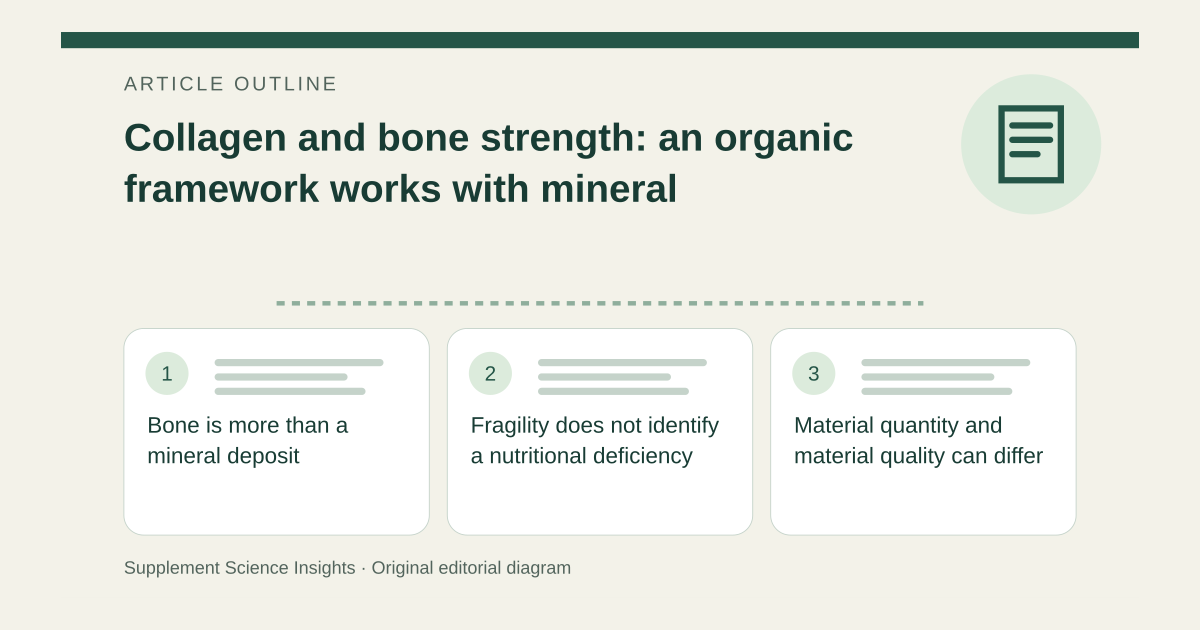
Bone is more than a mineral deposit
Collagen provides an organic framework that becomes mineralized with calcium phosphate. The combination contributes to bone’s mechanical properties. Describing bone only by its calcium content leaves out the organization and quality of its protein matrix. [1][2]
Type I collagen is a major structural component. MedlinePlus explains that some COL1A1 variants reduce the amount produced, while others alter its structure or assembly. These different changes can contribute to osteogenesis imperfecta, a condition involving bone fragility. [1][2]
Fragility does not identify a nutritional deficiency
A genetic production problem differs from inadequate nutrient intake. The presence of brittle bone alone cannot establish which process is responsible, and a collagen product does not automatically address an altered gene or defective assembly. [1][2]
The cited biology does not demonstrate that an oral supplement prevents fractures, treats osteoporosis or speeds fracture healing. Those are clinical outcomes requiring studies in the relevant population. Bone-health assessment should consider the actual diagnosis and care plan rather than assume that one constituent is missing. [1][2]
Material quantity and material quality can differ
Imagine two structures contain similar mineral amounts but have differently organized internal frameworks. A mineral measurement alone would not describe every mechanical difference. The analogy illustrates why bone composition is more than one number; it does not predict a person’s fracture risk.
| Level or observation | Meaning |
|---|---|
| Mineral content | One contributor |
| Collagen framework | Another contributor |
| Fracture risk | A clinical outcome with multiple determinants |
Sources for this article
- StatPearls: Biochemistry, Collagen Synthesis
Source consulted: 2026-09-17. This is a reference resource, not a claim that we conducted the studies or tested a product. - MedlinePlus Genetics: COL1A1
Source consulted: 2026-09-17. This is a reference resource, not a claim that we conducted the studies or tested a product.