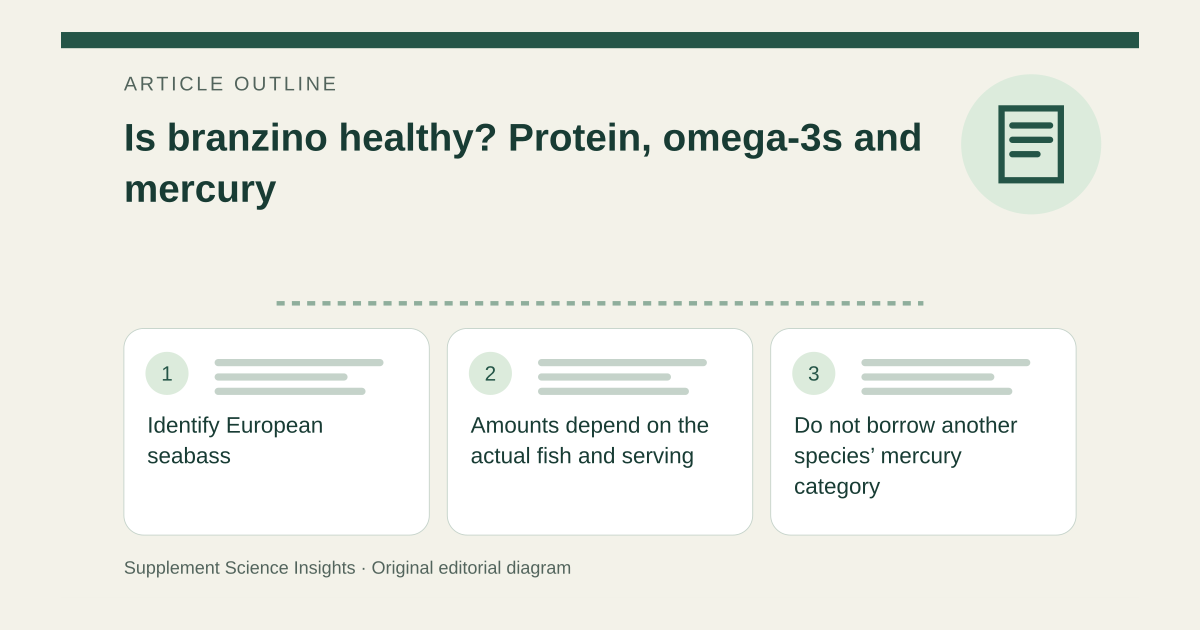
Identify European seabass
FAO identifies European seabass as Dicentrarchus labrax. The BIM nutrition handbook uses that species name and highlights protein, omega-3s, vitamin B12 and several other nutrients. These composition findings support a food choice, not a guarantee of disease prevention. [1][2]
Amounts depend on the actual fish and serving
A database entry or supplier label is more useful when species, preparation and serving weight match the food. Avoid copying exact values from a mixed-species sea-bass entry and presenting them as a measured result for every branzino fillet. Added oil, batter and sauces change the finished meal. [2][3]
Do not borrow another species’ mercury category
The inspected FDA/EPA advice does not give an explicit branzino entry. A category for black sea bass or Chilean sea bass should not be silently reassigned. For pregnancy, children or frequent consumption, use clearly identified choices in applicable guidance or obtain source-specific advice. [4][1]
Make a species-aware choice
Imagine a restaurant menu says only sea bass. Ask which species is served instead of assuming the lowest-mercury category. Pair the fish with a varied meal and favor preparations that do not add large amounts of salt or frying fat. [4][3]
| Question | Practical interpretation |
|---|---|
| Dicentrarchus labrax | European seabass |
| Mixed-species nutrition entry | Not a batch measurement |
| Different sea-bass name | Check the species |
| Pregnancy or child | Use appropriate fish advice |
Sources for this article
- FAO- Dicentrarchus labrax
Source consulted: 2026-09-21. This is a reference resource, not a claim that we conducted the studies or tested a product. - BIM Seafood Nutrition Handbook: seabass
Source consulted: 2026-09-21. This is a reference resource, not a claim that we conducted the studies or tested a product. - Fish and shellfish - NHS
Source consulted: 2026-09-21. This is a reference resource, not a claim that we conducted the studies or tested a product. - Advice about Eating Fish | FDA
Source consulted: 2026-09-21. This is a reference resource, not a claim that we conducted the studies or tested a product.