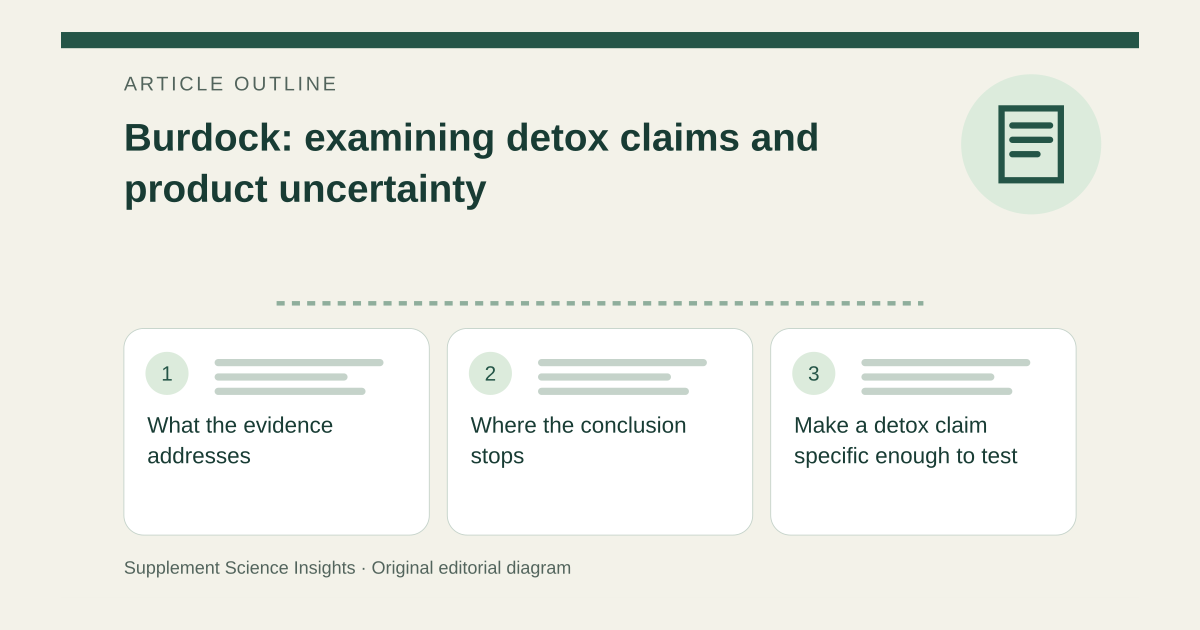
What the evidence addresses
Burdock root is eaten as food, while other preparations are marketed as herbal remedies. MSK describes early research on several uses, including small studies of tea and combination formulas. Confirmatory studies are needed; traditional use is not proof that a supplement treats disease. [1]
Where the conclusion stops
A change in an inflammatory marker does not establish pain relief or a useful “detox” effect. Studies of mixtures also cannot identify burdock as the ingredient responsible for a result. [1]
Make a detox claim specific enough to test
Suppose a tea says it “cleanses the body” but names no substance, measurement or clinical outcome. There is no clear result to compare with a study. Ask the seller to identify exactly what changes, how it was measured and in whom. A longer ingredient list does not answer those questions.
If a study instead measured a blood marker, read that result on its own terms. It may be a starting point for research, but an advertisement still needs a reason to connect it to the benefit being promised. Keep the proposed benefit and the measured outcome on separate lines until that connection is demonstrated.
| Hypothetical claim | Missing evidence |
|---|---|
| Cleanses the body | A defined substance, outcome and valid comparison |
| A blend improved a marker | Whether burdock itself contributed |
| Traditionally used | Whether the proposed benefit was established in people |
Safety and treatment considerations
Burdock can cause allergic reactions, and MSK advises avoiding it during pregnancy. Its summary records a contaminated tea and a liver-injury report involving a multi-ingredient detox tea. These reports raise product-quality concerns but do not prove that every burdock product has the same risk. [1]
A useful next step
No burdock product is recommended in this overview. Food, tea and concentrated extracts should not be treated as equivalent merely because their labels share a plant name.
Sources for this article
- Memorial Sloan Kettering Cancer Center — Burdock
Source consulted: 2026-09-17. This is a reference resource, not a claim that we conducted the studies or tested a product.