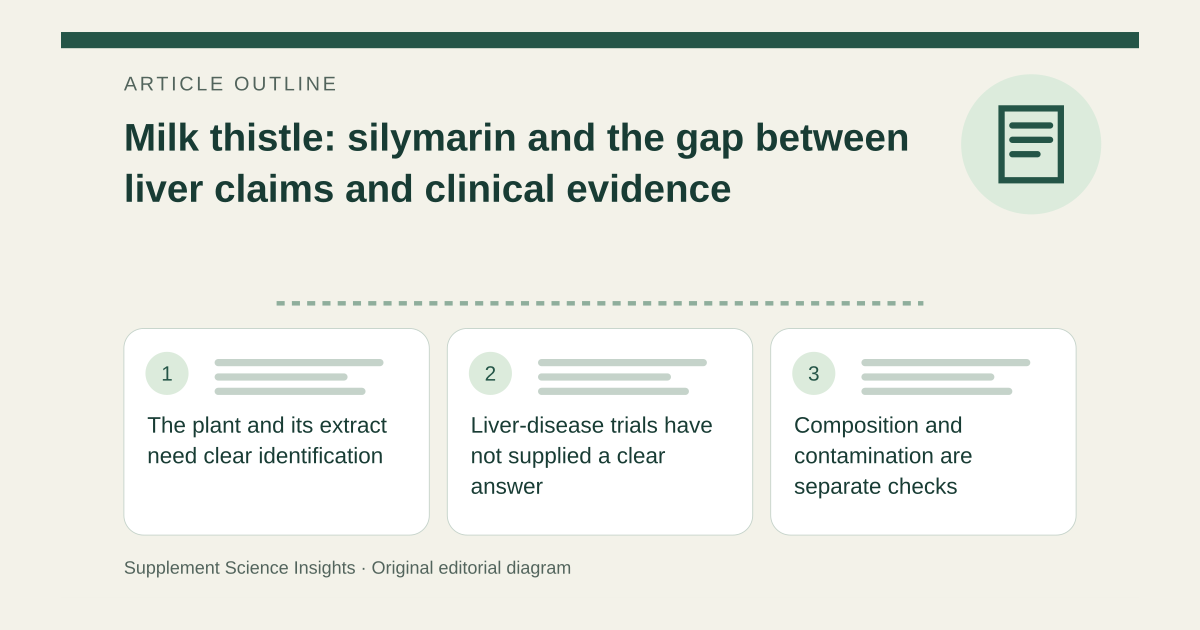
The plant and its extract need clear identification
Milk thistle, Silybum marianum, is commonly sold in products that highlight silymarin, a mixture of constituents. Total extract mass and declared silymarin content are different quantities. A product should identify both when that comparison is relevant. [1]
Different formulations should not automatically borrow one another's results. A familiar association with the liver explains the marketing category, but it does not establish effectiveness for a particular cause or stage of liver disease. [1]
Liver-disease trials have not supplied a clear answer
NCCIH describes conflicting or limited results across several liver conditions. Its summary notes that funded trials involving hepatitis C and a progressive form of fatty liver disease did not demonstrate benefit from silymarin supplementation. [1]
Some small studies suggest glucose-related effects in type 2 diabetes, but the evidence has limited geographic and study scope. That is a separate question from treating liver disease. Evidence about increasing breast-milk production is also unclear, and a product should not combine these uncertain uses into a general benefit claim. [1]
Composition and contamination are separate checks
Studies of marketed products have raised concerns about inaccurate silymarin amounts and contamination with substances such as microorganisms or mycotoxins. This does not establish that every product is defective; it shows why identity and quality evidence must concern the actual material. [1]
A favorable quality result would establish something about composition or contamination, not clinical effectiveness. Conversely, citing a clinical paper does not verify the contents of a bottle. Those two types of evidence answer different questions and should be presented separately. [1]
Tolerance does not establish liver protection
Oral milk thistle is often tolerated, but bloating, nausea and gas can occur. Allergic reactions are possible, especially in people sensitive to related plants such as ragweed or daisies. Medicine use should be discussed with a clinician or pharmacist. [1]
Pregnancy and breastfeeding safety information is limited. A liver-support label should not be used to assume that another supplement or alcohol exposure has become harmless. This page does not provide a strategy for offsetting a potentially damaging exposure. [1]
Calculate a declared mixture without overstating it
Imagine a fictional serving lists 250 mg extract standardized to 80 percent silymarin. The declared silymarin amount is 200 mg. Another label listing 250 mg seed powder cannot automatically be assigned the same composition.
The calculation does not establish absorption, liver benefit or an appropriate dose. It simply distinguishes an extract's mass from the amount of its declared constituent mixture.
| Fictional declaration | Interpretation |
|---|---|
| 250 mg extract; 80% silymarin | 200 mg declared silymarin |
| 250 mg seed powder | Composition not equivalent |
| Calculated amount | Not an efficacy or dosing conclusion |
A named organ is not a demonstrated outcome
Ask which liver condition, which preparation and which meaningful outcome a claim concerns. This overview does not recommend milk thistle as treatment or as protection against another exposure. Quality checks and clinical evidence both matter, but neither replaces the other.
Sources for this article
- NCCIH — Milk thistle: Usefulness and Safety
Source consulted: 2026-09-17. This is a reference resource, not a claim that we conducted the studies or tested a product.