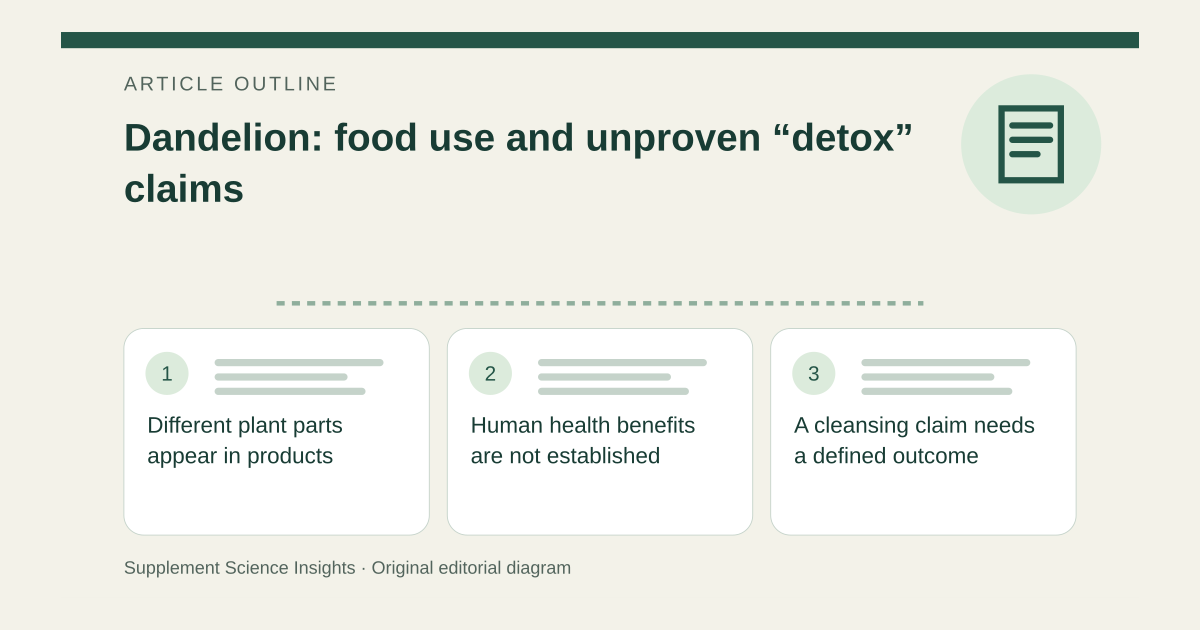
Different plant parts appear in products
Dandelion is used as a food and in products made from leaves, roots or extracts. These materials are not chemically identical, and the preparation should remain explicit when any research is discussed. A root product cannot automatically borrow a leaf-product finding. [1]
The familiar name can make a supplement seem simpler than it is. A blend may add other herbs, and a liquid may have a different extraction process from a tea. The complete formulation matters more than a general botanical reputation. [1]
Human health benefits are not established
NCCIH reports very little human research and no compelling evidence supporting dandelion for a health condition. Laboratory work on antioxidant or anti-inflammatory activity is preliminary and does not establish a therapeutic effect in people. [1]
A result in cells can help researchers choose a question, but it cannot answer whether a person benefits after taking an oral product. Dose, absorption, metabolism, clinical outcomes and harms still need investigation. [1]
A cleansing claim needs a defined outcome
The term detox often leaves the supposed toxin, exposure and intended improvement unspecified. Without those details, almost any change can be described as success and failures become difficult to recognize.
A useful question asks what substance is being removed, how that was measured and whether the change improved health. More urination, a temporary weight change or a different laboratory value would not automatically establish removal of a harmful exposure or treatment of disease.
A product that produces more urine has not thereby demonstrated removal of an unspecified toxin. A detoxification claim needs a named substance, a validated measurement and evidence that the change improves health.
Food amounts do not establish extract safety
Dandelion in ordinary food amounts is considered likely safe, but larger or concentrated exposures are less well studied. Allergy is possible, and theoretical interactions include diabetes medicines, anticoagulants, antiplatelet drugs and diuretics. [1]
Pregnancy and breastfeeding information beyond food use is limited. Someone taking a prescribed water pill or managing fluid balance should not add an herbal product on the assumption that overlapping effects must be helpful. [1]
A blend weight does not identify dandelion exposure
Imagine a bottle declares 600 mg of a three-herb cleansing blend, listing dandelion first but giving no individual quantities. It does not establish 600 mg of dandelion or 200 mg of each herb.
A second label naming 300 mg dandelion root powder provides a clearer ingredient amount, but clarity is not evidence of benefit. This fictional comparison separates disclosure from efficacy and avoids turning a readable label into a treatment recommendation.
| Fictional label | Dandelion amount |
|---|---|
| 600 mg three-herb blend | Unknown |
| 300 mg root powder | Declared 300 mg; benefit not established |
Use a defined problem rather than a vague promise
A food choice can be assessed as part of the diet. A claimed treatment requires evidence for the actual preparation and outcome. This reference does not provide a detox protocol, diagnose fluid retention or endorse a dandelion supplement.
Sources for this article
- NCCIH — Dandelion: Usefulness and Safety
Source consulted: 2026-09-17. This is a reference resource, not a claim that we conducted the studies or tested a product.