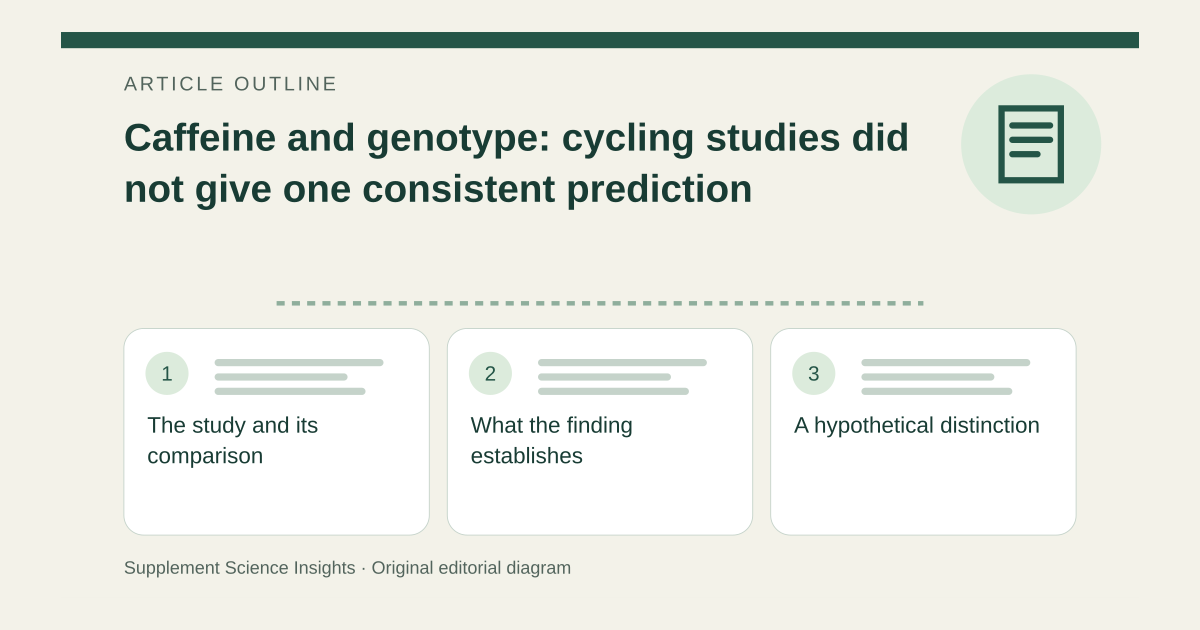
The study and its comparison
A blinded study of 101 competitive male athletes tested placebo and two caffeine amounts before a cycling time trial. Performance effects differed by CYP1A2 genotype, with some groups improving and another worsening at the higher amount. [1][2]
A separate crossover study of eighteen adults found improved cycling performance with caffeine but no difference in the exercise effect between the studied genotype groups. Some cognitive comparisons did differ. [1][2]
What the finding establishes
Different exercise protocols, small genetic subgroups and inconsistent findings limit personal predictions. A genotype label alone is not a validated dosing instruction. Funding and conflicts were not established from the retrieved abstracts. Caffeine’s effect on one timed test should not be described simply as more energy. [1][2]
A hypothetical distinction
Imagine a genetic subgroup finding fails to appear in a second exercise study. A deterministic consumer prediction would be premature.
| Detail | Interpretation |
|---|---|
| Measured outcome | Keep the endpoint specific |
| Study preparation | Not every retail product |
| Remaining uncertainty | Not resolved by a mechanism |
Sources for this article
- Caffeine, CYP1A2 Genotype, and Endurance Performance in Athletes.
Source consulted: 2026-09-19. This is a reference resource, not a claim that we conducted the studies or tested a product. - The effect of caffeine on cognitive performance is influenced by CYP1A2 but not ADORA2A genotype, yet neither genotype affects exercise performance in healthy adults.
Source consulted: 2026-09-19. This is a reference resource, not a claim that we conducted the studies or tested a product.