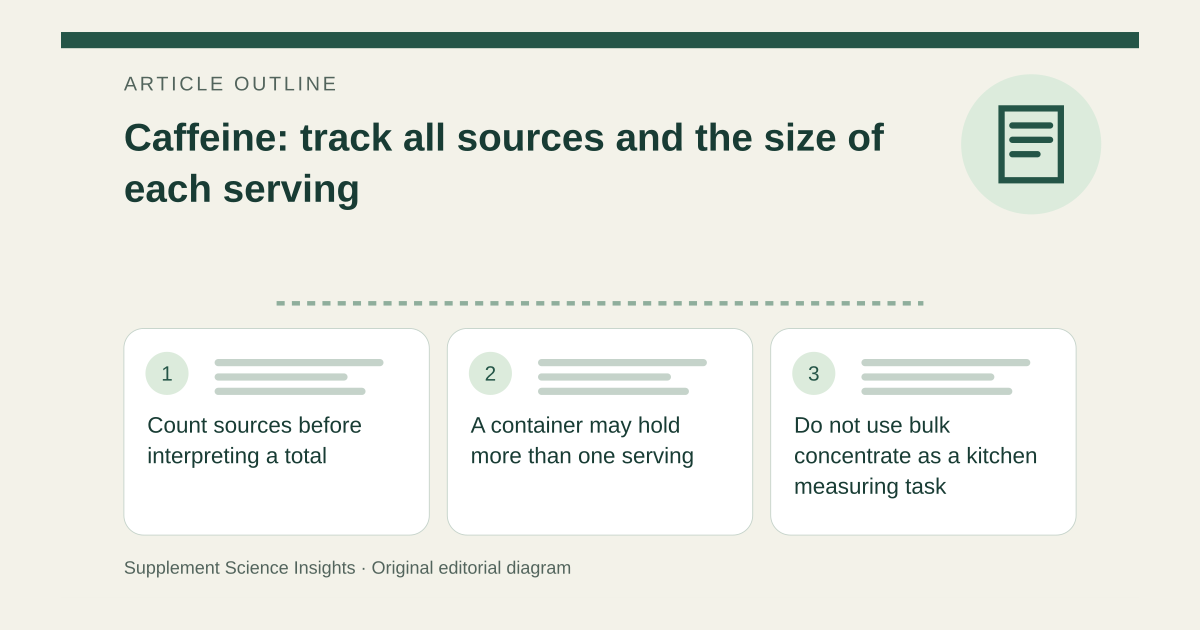
Count sources before interpreting a total
Caffeine can come from drinks, foods and supplements. FDA emphasizes that sensitivity and elimination vary between people, and medicines and medical conditions can affect the response. A general population reference is not a personal guarantee of safety. [1]
Begin a dated record with the product, portion, declared caffeine and time. Distinguish a full container from one labeled serving. If a drink’s caffeine quantity is estimated, preserve the source of the estimate rather than presenting it as measured. [1]
A container may hold more than one serving
An invented drink declares 40 mg caffeine per serving and two servings per bottle. The full bottle therefore accounts for 80 mg according to its label. An additional fictional 30 mg entry in the same recording period brings those documented entries to 110 mg.
This is an arithmetic exercise, not a recommendation to consume these products together. The total excludes missing entries and does not show how much caffeine remains in the body. Keep the times and actual portions alongside the quantities.
| Field | Quantity |
|---|---|
| Caffeine per drink serving | 40 mg |
| Servings per bottle | 2 |
| Full bottle by label arithmetic | 80 mg |
| Other recorded entry | 30 mg |
| Sum of recorded entries only | 110 mg |
Do not use bulk concentrate as a kitchen measuring task
FDA warns that pure and highly concentrated caffeine products can cause serious harm, including death. Avoid treating a household spoon or an online conversion as a way to portion these products safely. [1]
The worked example concerns declared servings of invented finished products. It deliberately supplies no powder-mixing, dilution or concentrate-measuring instructions. A product’s apparent affordability or small serving size does not resolve the risk of a measurement error. [1]
The same amount can be a different experience
Too much caffeine can cause palpitations, anxiety, sleep disruption and gastrointestinal symptoms. FDA advises discussing relevant conditions and medicines with a health professional, including whether to limit caffeine during pregnancy or breastfeeding. [1]
A record of products, amounts and timing can make that conversation more useful. Do not treat discomfort as proof that adding another supplement will counteract it. This page does not supply a medical threshold or a strategy for overriding symptoms. [1]
An extract weight does not disclose caffeine by itself
If a label lists only the weight of a tea or botanical extract, do not enter that whole weight as caffeine. Look for the separately declared caffeine amount and what the declaration covers. An ambiguous “total” needs clarification before it can be added reliably.
Record whether the number includes all caffeine sources in a blend. If that is unclear, mark it unknown. Combining a stated caffeine amount with an assumed extra amount can double-count the same ingredient or miss an undisclosed contribution.
What the intake record can and cannot show
The fictional bottle calculation establishes 80 mg from its two declared servings and 110 mg across the two recorded products. It does not establish an appropriate intake, individual blood concentration or performance benefit.
The FDA resource supports the cited safety context. Specific sports-performance effects and combination-product claims require separate appraisal of the original evidence. Independent scientific and editorial acceptance remains pending.
Sources for this article
- FDA — Spilling the Beans: How Much Caffeine is Too Much?
Source consulted: 2026-09-17. This is a reference resource, not a claim that we conducted the studies or tested a product.