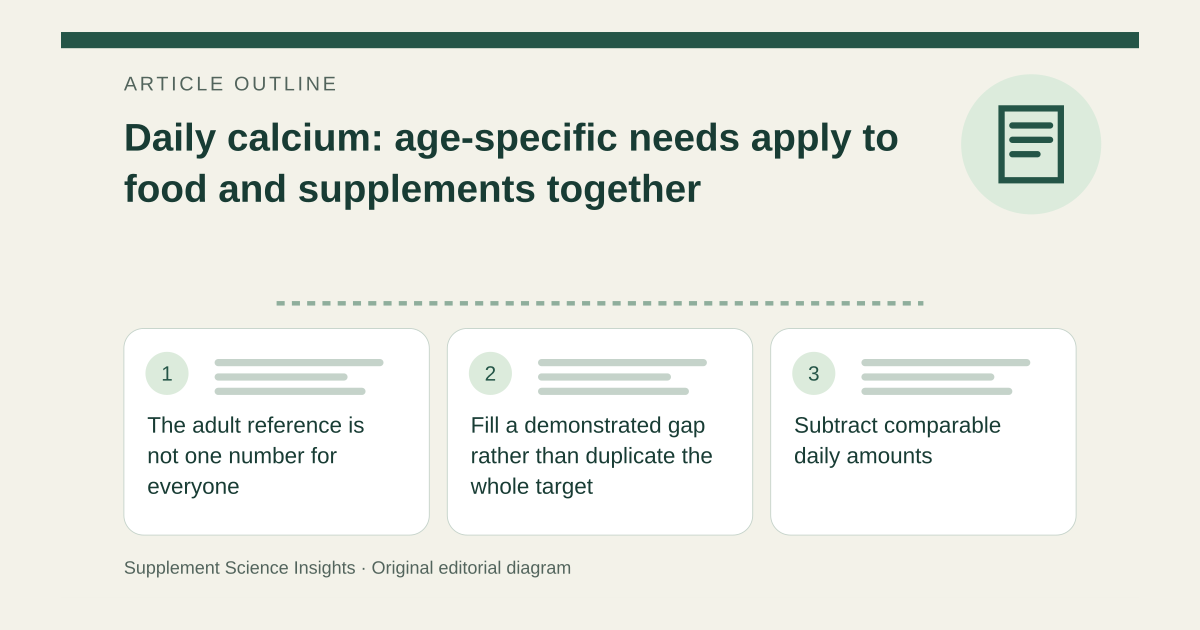
The adult reference is not one number for everyone
ODS lists 1,000 mg of calcium daily for adults aged 19–50. At ages 51–70, the reference is 1,000 mg for men and 1,200 mg for women; adults older than 70 have a 1,200-mg reference. Adolescents aged 9–18 have a higher 1,300-mg reference for growth. [1]
These values describe total oral intake for generally healthy groups. An age-specific requirement is not a supplement serving to add regardless of milk, yogurt, fortified foods or other calcium sources already consumed. [1]
Fill a demonstrated gap rather than duplicate the whole target
Food portions, fortification and actual product use determine the dietary estimate. Calcium-containing antacids also contribute and should be included when reviewing exposure. The elemental calcium amount is the relevant nutrient entry. [1]
An upper intake limit describes a different safety boundary and is not a goal. Kidney conditions, stone history and medication interactions can change the individual plan, so being below a population limit does not establish that supplementation is appropriate. [1]
Subtract comparable daily amounts
Imagine a clinician’s hypothetical total-intake plan is 1,000 mg and the estimated food contribution is 800 mg. The arithmetic gap is 200 mg, not another 1,000 mg. This example illustrates accounting; it neither sets a personal target nor requires a supplement to fill that gap.
| Detail | Interpretation |
|---|---|
| Plan: 1,000 mg total | Food plus other sources |
| Food estimate: 800 mg | Already contributes |
| Difference: 200 mg | Could be addressed through the agreed plan |
Sources for this article
- NIH ODS: Calcium
Source consulted: 2026-09-17. This is a reference resource, not a claim that we conducted the studies or tested a product.