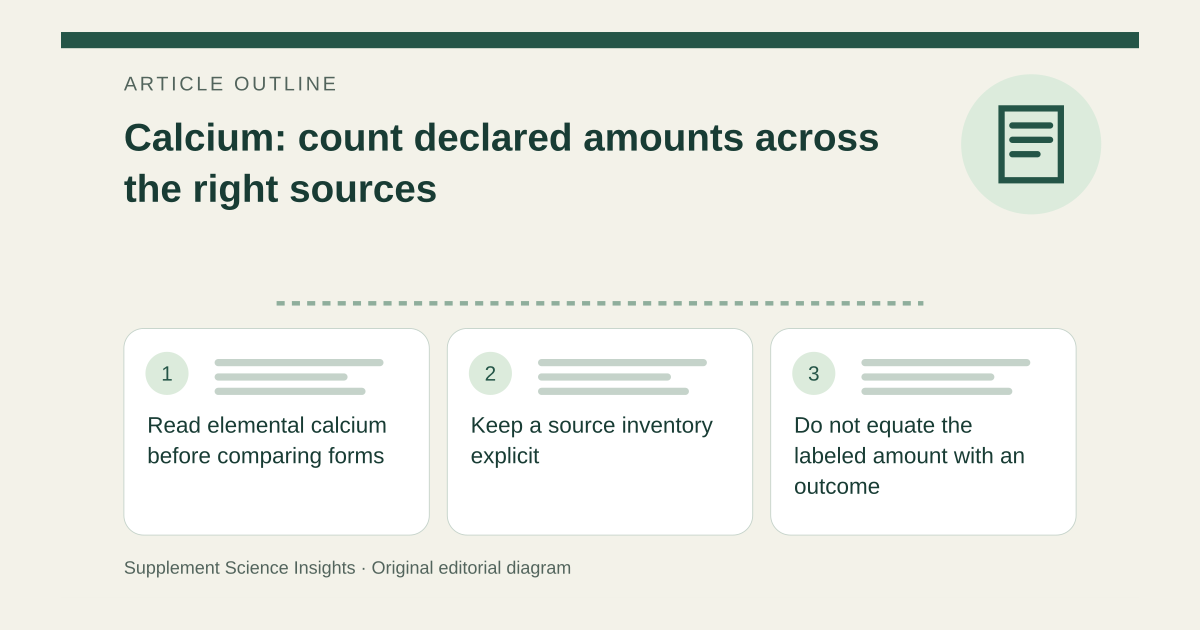
Read elemental calcium before comparing forms
Calcium carbonate and calcium citrate are common supplement forms. Supplement Facts declares elemental calcium rather than the entire compound’s weight. NIH ODS explains that citrate is less dependent on stomach acid and that food can improve carbonate absorption, particularly with low stomach acid. [1]
Record the elemental amount, form and serving definition before considering a claim about convenience or absorption. The compound name does not replace the label’s directions or establish a personal intake target. [1]
Keep a source inventory explicit
Imagine a record containing 300 mg calcium from one food entry, 200 mg from a supplement entry and 100 mg from a calcium-containing antacid entry, all for the same recorded period. Those three invented entries sum to 600 mg.
The total describes only this fictional record. It is not a recommended daily intake, a complete dietary assessment or an instruction to combine those products. An undocumented meal or medicine must remain outside the calculation until its amount and use are actually known.
| Entry | Declared or recorded calcium |
|---|---|
| Food entry | 300 mg |
| Supplement entry | 200 mg |
| Antacid entry | 100 mg |
| Sum of these entries only | 600 mg |
| Personal daily requirement | Not determined |
Do not equate the labeled amount with an outcome
The fraction of calcium absorbed generally declines as the amount taken at one time increases. Supplements can cause gas, bloating or constipation. These points do not establish a universal product winner or prove that a particular supplement prevents fractures. [1]
When evaluating an absorption claim, record the dose, preparation and measured endpoint. Then ask whether the advertised outcome was studied directly. This page does not translate an absorption measurement into a predicted change in bone strength. [1]
Include antacids and prescribed medicines
Calcium can interfere with medicines such as levothyroxine and certain antibiotics. A pharmacist should review the specific preparations and timing. Bring calcium-containing antacids into that discussion rather than leaving them off the list because they are not marketed as supplements. [1]
A history of kidney stones or kidney disease also deserves individualized clinical advice. Do not change prescribed treatment or impose a dietary restriction using this label worksheet. It cannot settle those decisions. [1]
Match serving units and time periods
Distinguish a per-tablet amount from a per-serving amount, and record how many units the serving contains. For foods, retain the portion used by the source. A number without its portion or time period is not ready to add to a total.
Keep estimated food entries visibly separate from copied label declarations. If the record covers only part of a day, label it that way. This prevents a partial worksheet from being mistaken for a measured daily intake.
A source total is a starting point for discussion
The useful result of the invented worksheet is a transparent sum with explicit inputs. It supplies neither a diagnosis nor a personal calcium requirement. Choosing an intervention requires the relevant health context and evidence.
The source below is a government synthesis. This article does not independently resolve conflicting outcome studies, compare retail batches or verify fracture-prevention claims. Independent scientific and editorial acceptance remains pending.
Sources for this article
- NIH ODS — Calcium: Health Professional Fact Sheet
Source consulted: 2026-09-17. This is a reference resource, not a claim that we conducted the studies or tested a product.
Considering a supplement?
Ingredient evidence alone does not establish which retail product is suitable. The featured option illustrates the label and formulation context above; it is not a clinical efficacy ranking.
Compare calcium formulations (retail checks pending) → No overall winner
Compare formulations → · How we select products