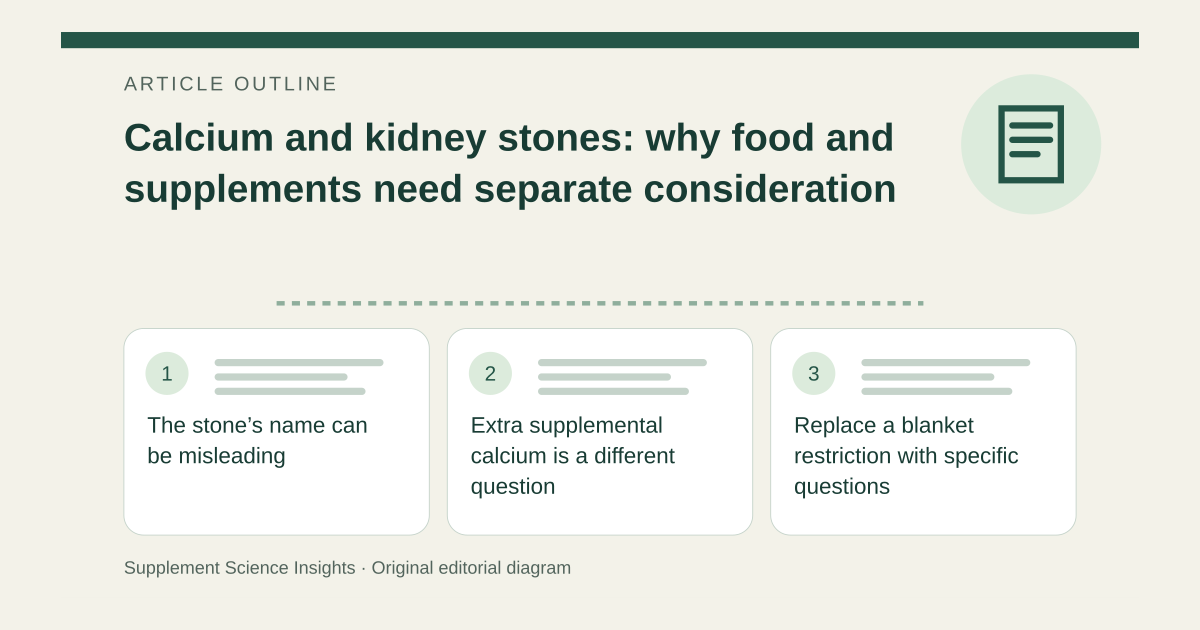
The stone’s name can be misleading
For calcium oxalate stones, NIDDK advises getting enough calcium from foods rather than automatically avoiding calcium. Calcium in the digestive tract can bind substances involved in stone formation. Cutting dietary calcium indiscriminately can therefore miss an important part of prevention. [1]
This does not mean unlimited calcium is protective. The advice is to obtain an appropriate amount within a stone-prevention plan. Someone with a prior stone should establish its type before adopting a restrictive diet. [1]
Extra supplemental calcium is a different question
ODS describes evidence that higher supplemental calcium intake might increase kidney-stone risk, but also notes subsequent reviews that did not find an association. These findings do not support a universal claim that every calcium supplement causes stones or that supplements are risk-free. [2]
A personal review should include the supplement’s purpose, the amount already obtained from food and any calcium-containing medicines. Evidence about one combined calcium-and-vitamin-D regimen should not be treated as proof of the isolated effect of either nutrient. [2]
Replace a blanket restriction with specific questions
Imagine someone stops all calcium-rich foods after hearing that a removed stone contained calcium. A more useful follow-up is to ask which kind of stone it was, what the urine assessment showed and how food calcium fits the recommended diet.
The answer might involve several parts of the diet, not just calcium. This scenario is a prompt for an individualized plan rather than a menu for every stone former.
| Observation | Interpretation |
|---|---|
| Stone type | Determines which diet advice applies |
| Food calcium | Do not remove automatically |
| Supplement and antacid use | Review the additional exposure |
Prevention depends on more than calcium
NIDDK identifies fluid intake, sodium, animal protein and oxalate as relevant considerations depending on stone type. It also cautions that fluid advice can differ with kidney failure. A generic instruction to drink as much as possible is not suitable for every reader. [1][2]
Discuss proposed supplements with the clinician managing the stones. Keeping adequate nutrition while reducing recurrence risk is more useful than treating all foods containing the mineral as forbidden. [1][2]
Sources for this article
- NIDDK — Eating, Diet, & Nutrition for Kidney Stones
Source consulted: 2026-09-17. This is a reference resource, not a claim that we conducted the studies or tested a product. - NIH ODS — Calcium: Health Professional Fact Sheet
Source consulted: 2026-09-17. This is a reference resource, not a claim that we conducted the studies or tested a product.