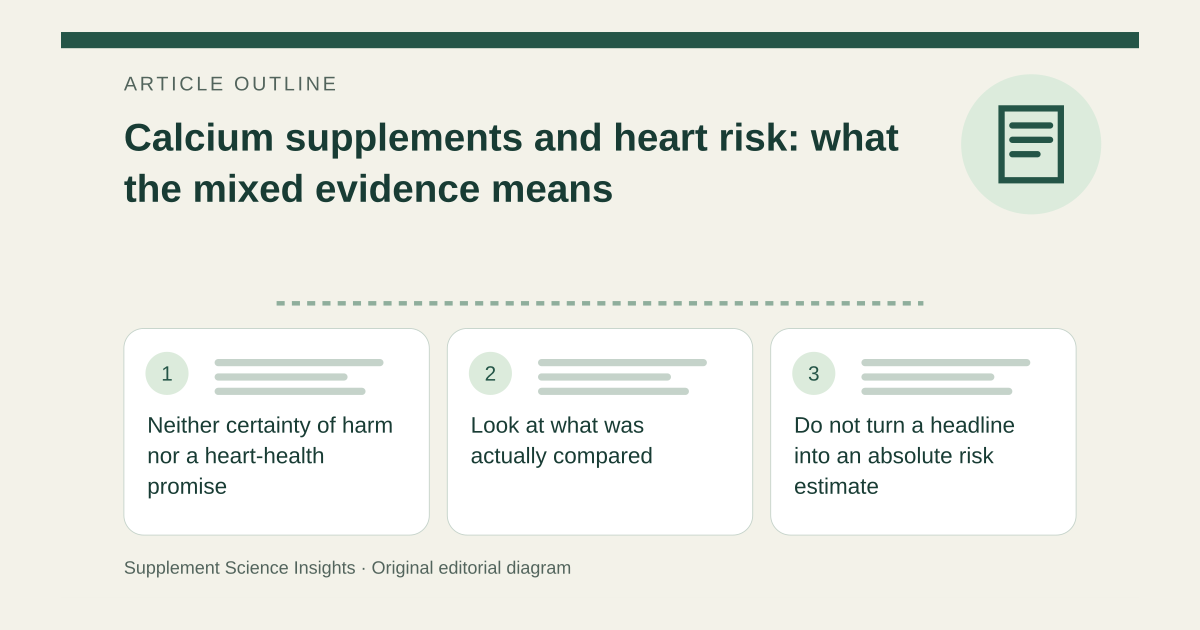
Neither certainty of harm nor a heart-health promise
NIH ODS describes mixed evidence on calcium supplements and cardiovascular disease. Some studies suggest increased risk, while others find no association. The summary calls for more research to clarify the relationship. [1]
That uncertainty should remain visible. It does not establish that an individual supplement caused a heart event, and it does not justify marketing calcium supplements as a proven way to prevent cardiovascular disease. [1]
Look at what was actually compared
Observational links between dietary calcium and health outcomes can reflect other differences between people. A randomized supplement trial addresses a more specific intervention, but its relevance still depends on the participants, amount, duration and whether vitamin D was given at the same time. [1]
Changes in blood pressure or cholesterol are also different outcomes from heart attacks or cardiovascular deaths. A favorable change in one marker is not, on its own, proof that a supplement prevents those events. This page reports the ODS assessment rather than independently reappraising every underlying trial. [1]
Do not turn a headline into an absolute risk estimate
Imagine two headlines: one says calcium-rich diets are associated with better cardiovascular outcomes; another raises concern about supplements. The apparent disagreement may involve different exposures, populations and study designs.
Without those details and baseline event rates, the headlines do not yield a meaningful numerical estimate of personal benefit or harm. They do provide a reason to review whether extra calcium is needed.
| Observation | Interpretation |
|---|---|
| Diet association | May include other lifestyle differences |
| Supplement trial | Check dose, participants and co-treatment |
| Personal decision | Start with the reason for extra calcium |
Make a purpose-based decision
ODS recommends obtaining nutrients primarily from foods, including fortified foods, with supplements useful when needs cannot otherwise be met. A prescribed calcium regimen may have a specific bone or mineral-management purpose that should be discussed before changing it. [1]
Review total intake, kidney history and medicines as well as the cardiovascular question. An age-specific upper intake limit is a ceiling for general safety assessment, not an instruction to consume that amount or a guarantee against every possible risk. [1]
Sources for this article
- NIH ODS — Calcium: Health Professional Fact Sheet
Source consulted: 2026-09-17. This is a reference resource, not a claim that we conducted the studies or tested a product.