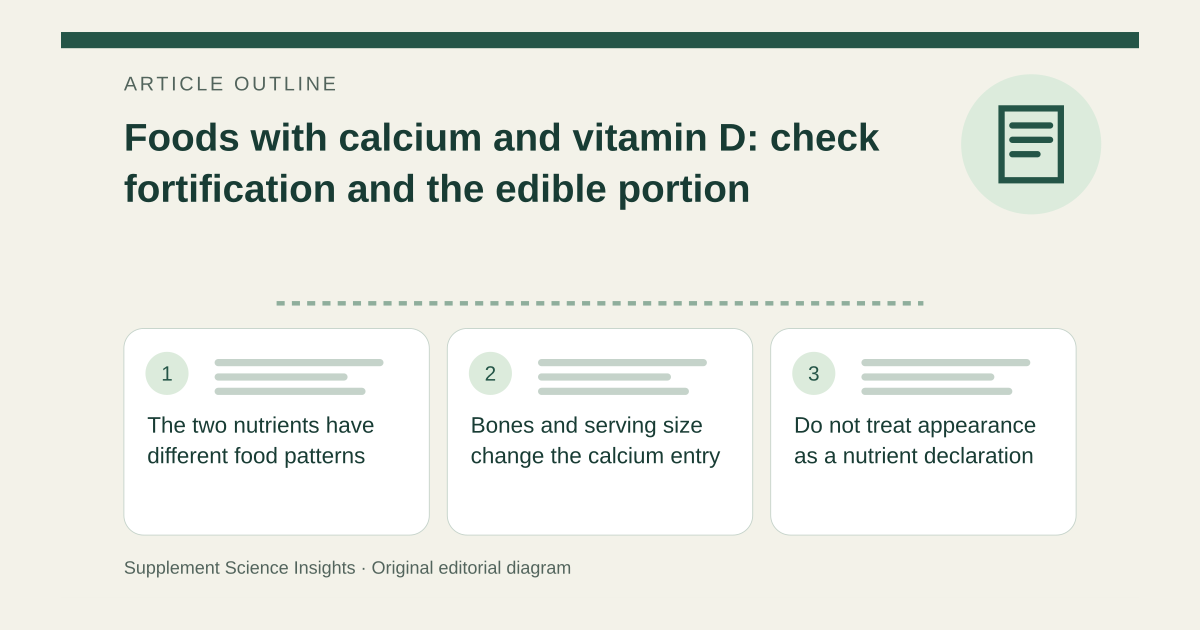
The two nutrients have different food patterns
Dairy foods are important calcium sources, while naturally vitamin-D-rich foods include fatty fish. In the United States, milk is commonly fortified with vitamin D, and some plant beverages and other foods are fortified as well. Fortification should be checked for the actual product. [1][2]
Cheese being calcium-rich does not establish the same vitamin D contribution as fortified milk. Similarly, a plant beverage that resembles milk can have a different nutrient profile when it is not fortified. [1][2]
Bones and serving size change the calcium entry
ODS lists canned sardines and salmon with bones as calcium sources. Removing or not eating the bones changes the relevant edible portion, so a table entry explicitly describing fish with bones should not be copied for a boneless portion. [1][2]
For both nutrients, retain the serving size and food preparation. The same nutrient name across two tables does not make their portions identical. Food-source information supports an intake estimate rather than a guaranteed amount in every brand or meal. [1][2]
Do not treat appearance as a nutrient declaration
Imagine two cartons are both labeled as plant beverages, but only one declares added calcium and vitamin D. They cannot be counted as equivalent fortified sources merely because the serving volumes are equal. Use the actual nutrient entries instead of the product category.
| Detail | Interpretation |
|---|---|
| Same volume | Comparable serving size |
| Different fortification | Potentially different nutrient contribution |
| Actual label amounts | Basis for the estimate |
Sources for this article
- NIH ODS: Calcium
Source consulted: 2026-09-17. This is a reference resource, not a claim that we conducted the studies or tested a product. - NIH ODS: Vitamin D
Source consulted: 2026-09-17. This is a reference resource, not a claim that we conducted the studies or tested a product.