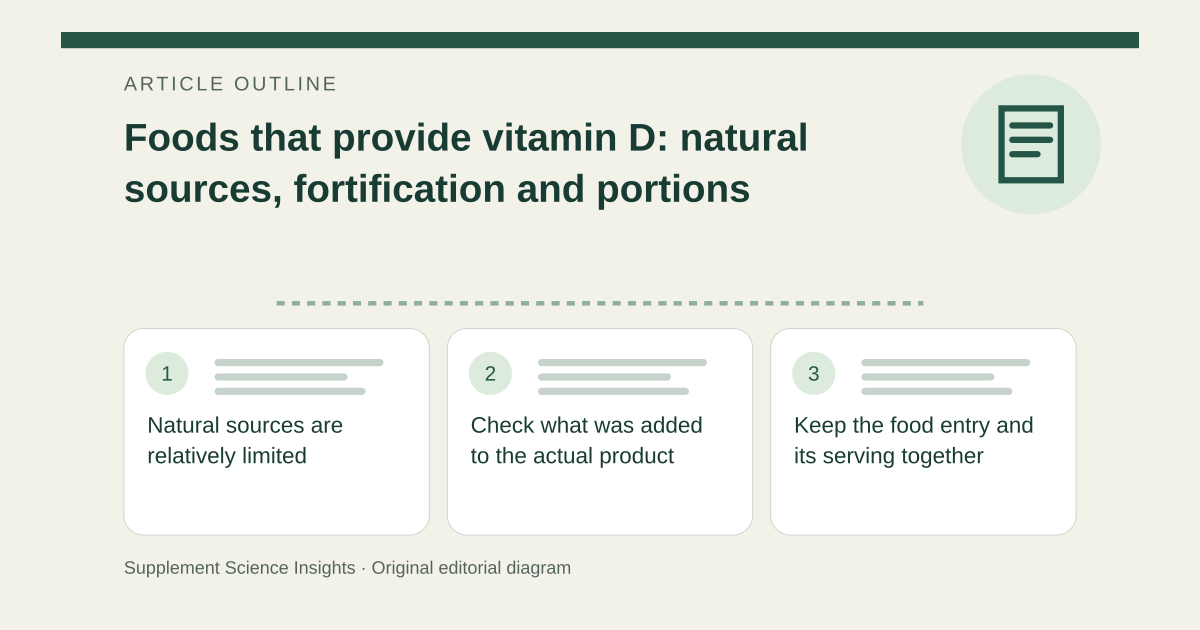
Natural sources are relatively limited
NIH ODS identifies fatty fish such as trout and salmon among the stronger natural food sources of vitamin D. Egg yolks, liver and cheese contain smaller amounts. Mushrooms vary: UV exposure can substantially increase their vitamin D2 content. [1]
A food that is nutritious in other ways is not necessarily a meaningful vitamin D source. The ODS table lists little or none for many common fruits, vegetables and grains. This is one reason fortified foods can make an important contribution. [1]
Check what was added to the actual product
Many milks, plant drinks and breakfast cereals are fortified, but the practice and amount vary. The label for the product being used is more reliable than assuming every item in its category has the same vitamin D content. [1]
Fortified milk does not imply that every cheese or yogurt made from milk is similarly fortified. Likewise, a plant drink can be a useful source when vitamin D is added, but the words “plant based” do not state its nutrient content. [1]
Keep the food entry and its serving together
The ODS table lists 14.2 micrograms for three ounces of cooked sockeye salmon, while a large scrambled egg supplies about 1.1 micrograms. These are specified reference portions, not a ranking of all fish against all eggs. Preparation and the exact food entry matter. [1]
The U.S. label Daily Value is 20 micrograms, or 800 IU, for adults and children aged four and older. A Daily Value is a labeling reference, not a personalized treatment target or a substitute for age-specific intake guidance. [1]
Add only the portions actually recorded
Suppose a hypothetical fortified drink supplies 3 micrograms per cup and a cereal supplies 2 micrograms per serving. One cup and one serving together supply 5 micrograms, equivalent to 200 IU. Half a cup of the drink with the same cereal would supply 3.5 micrograms instead.
Those calculations describe the invented labels and portions. They neither measure absorption nor establish that the rest of the day supplies enough vitamin D.
| Observation | Meaning |
|---|---|
| Drink: 3 micrograms per cup | One cup supplies 3 micrograms |
| Cereal: 2 micrograms per serving | One serving supplies 2 micrograms |
| Combined: 5 micrograms | Equivalent to 200 IU |
Food planning does not replace treatment when needed
Someone with a diagnosed deficiency, malabsorption or kidney-related disorder may need a plan beyond choosing foods. A more varied diet is useful context but does not determine the correct treatment or monitoring by itself. [1]
Do not use a food table to justify deliberate UV exposure or unsupervised high-dose supplements. This page supports dietary planning and makes no retail food or supplement endorsement. [1]
Sources for this article
- NIH ODS — Vitamin D: Health Professional Fact Sheet
Source consulted: 2026-09-17. This is a reference resource, not a claim that we conducted the studies or tested a product.