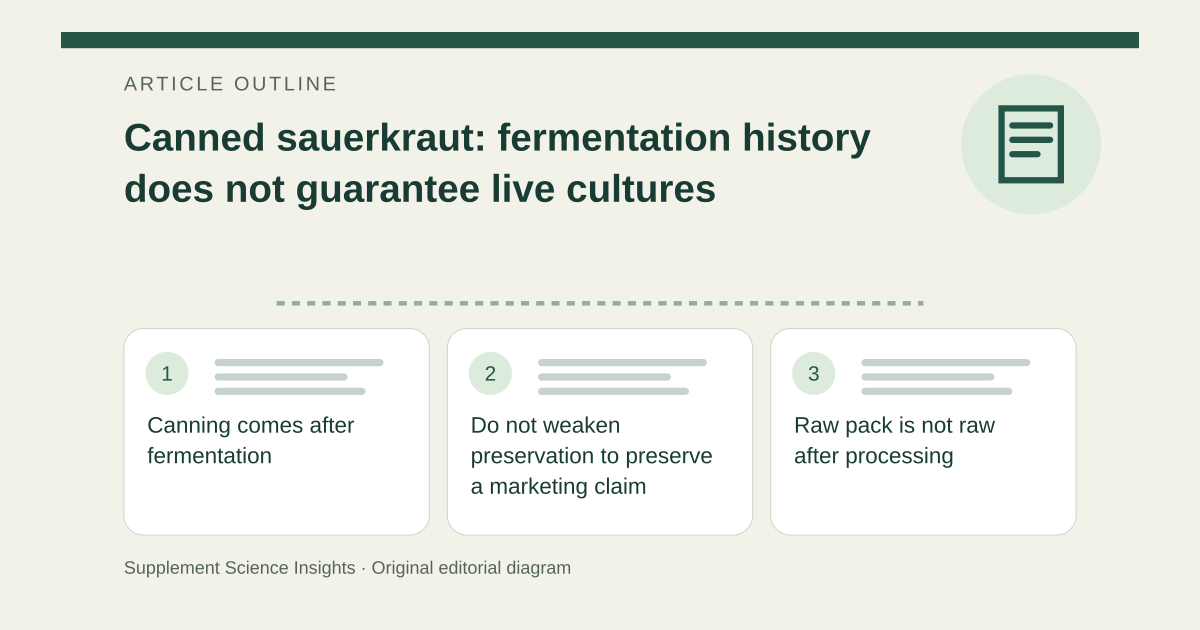
Canning comes after fermentation
The National Center for Home Food Preservation describes both hot-pack and raw-pack canning procedures followed by boiling-water processing. Raw pack describes how jars are filled, not a promise that the final canned food is unheated. [1][2]
The fermented-food consensus distinguishes heat-treated products from foods retaining live microorganisms. A history of fermentation does not resolve current viability. [1][2]
Do not weaken preservation to preserve a marketing claim
Follow a tested preservation process rather than shortening heat treatment to try to retain cultures. The cited canning guidance is about food safety, not maximizing probiotic delivery. [1][2]
A food can remain useful nutritionally without being a verified probiotic product. Live-culture status and demonstrated health benefit are additional questions. [1][2]
Raw pack is not raw after processing
Imagine a jar was filled using a raw-pack method and then properly canned. The method name does not establish that live fermentation cultures remain in the finished jar.
| Detail | Interpretation |
|---|---|
| Fermented | Production history |
| Canned | Later preservation step |
| Live cultures | Not guaranteed by the first step |
Sources for this article
- Sauerkraut - National Center for Home Food Preservation
Source consulted: 2026-09-18. This is a reference resource, not a claim that we conducted the studies or tested a product. - The International Scientific Association for Probiotics and Prebiotics (ISAPP) consensus statement on fermented foods | Nature Reviews Gastroenterology & Hepatology
Source consulted: 2026-09-18. This is a reference resource, not a claim that we conducted the studies or tested a product.