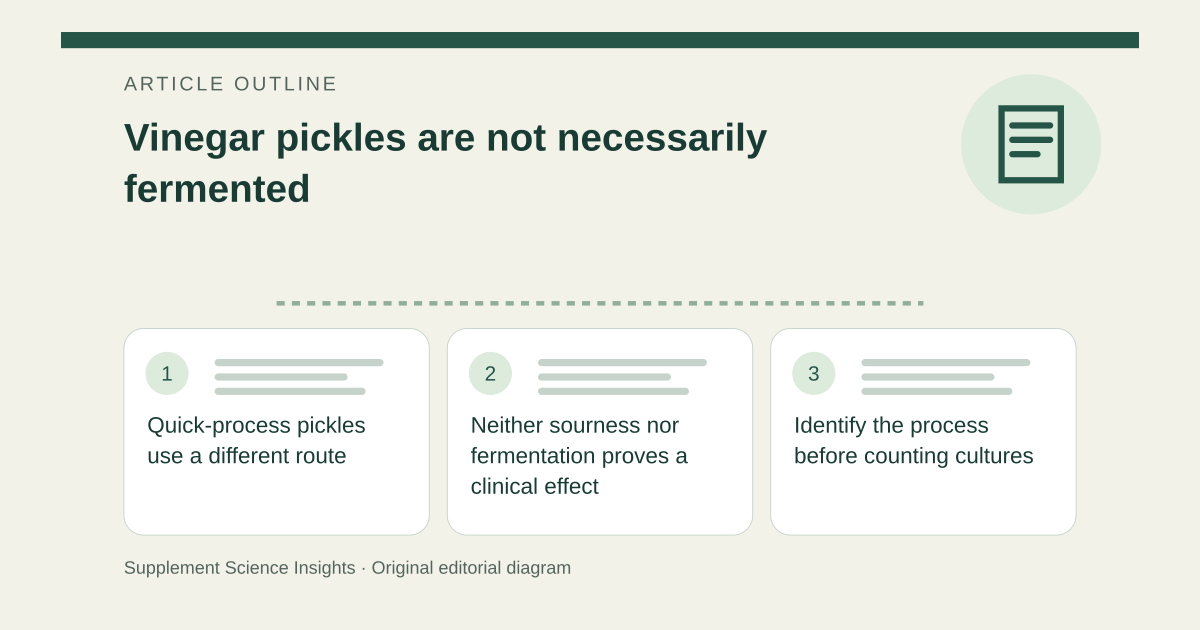
Quick-process pickles use a different route
The National Center for Home Food Preservation states that fresh-pack or quick-process pickles are not fermented. They may be briefly brined and then covered with vinegar and seasonings. [1][2]
Fermented pickles rely on a microbial process. Both can taste sour, so taste alone cannot identify how acidity was produced. [1][2]
Neither sourness nor fermentation proves a clinical effect
Even a fermented product needs appropriate live-organism and benefit evidence before a specific probiotic claim is justified. Later processing can also alter viability. [1][2]
For home preservation, use tested ingredient proportions and acidity. Reducing vinegar or changing a recipe to pursue live cultures can undermine the safety basis of the method. [1][2]
Identify the process before counting cultures
Imagine two jars taste equally sour, but one was vinegar-acidified and the other fermented. Their similar flavor does not establish the same microbial content.
| Detail | Interpretation |
|---|---|
| Added vinegar | Can acidify without fermentation |
| Microbial fermentation | Different process |
| Probiotic effect | Not established by sourness |
Sources for this article
- General Information on Pickling - National Center for Home Food Preservation
Source consulted: 2026-09-18. This is a reference resource, not a claim that we conducted the studies or tested a product. - Probiotics - Health Professional Fact Sheet
Source consulted: 2026-09-18. This is a reference resource, not a claim that we conducted the studies or tested a product.