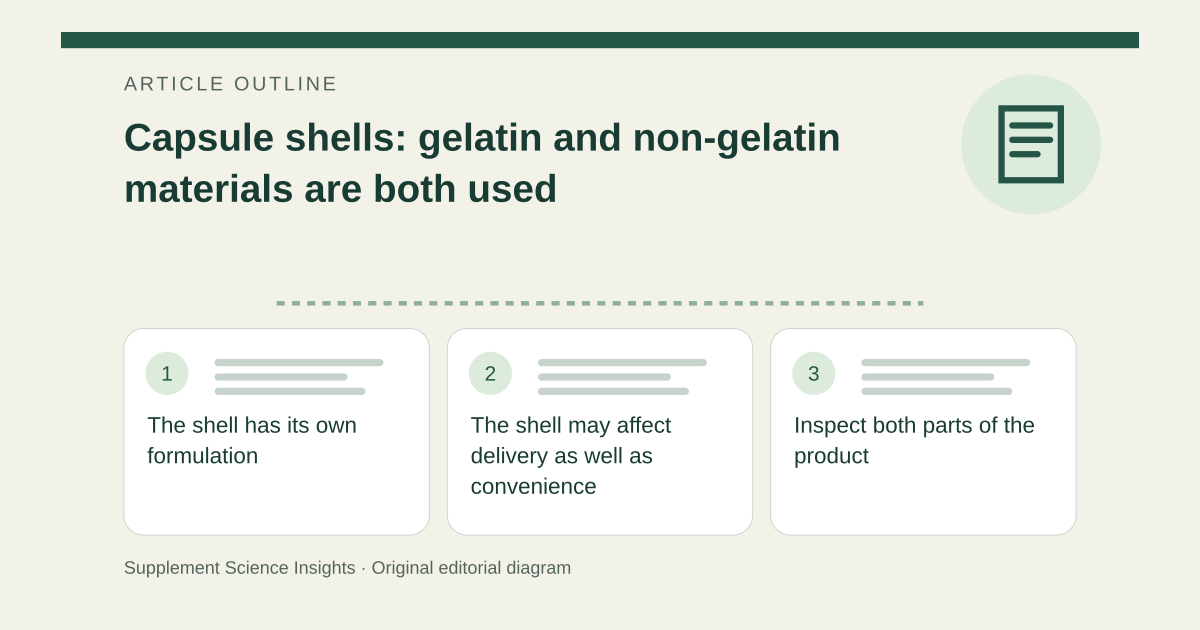
The shell has its own formulation
The cited pharmaceutical review describes shells made from gelatin or materials such as hypromellose and starch, with water and sometimes a plasticizer. Capsules can contain solids, liquids or semisolid fills. [1]
These are examples of materials, not a statement that every capsule contains all of them. Exact composition must be established for the particular preparation. [1]
The shell may affect delivery as well as convenience
The review also notes that shells can be designed to change where their contents are released in the digestive tract. Shell identity therefore is not always merely a cosmetic detail. [1]
For dietary restrictions or handling questions, inspect the other ingredients and manufacturer instructions. A plant-derived active ingredient does not prove that its capsule shell has the same origin. [1]
Inspect both parts of the product
Imagine a capsule contains a botanical powder but uses a gelatin shell. The origin of the powder alone does not establish the composition of the whole capsule.
| Detail | Interpretation |
|---|---|
| Fill | Active and other contents |
| Shell | Separate material |
| Release design | May influence handling |
Sources for this article
- Gelatin and Non-Gelatin Capsule Dosage Forms - PubMed
Source consulted: 2026-09-18. This is a reference resource, not a claim that we conducted the studies or tested a product.