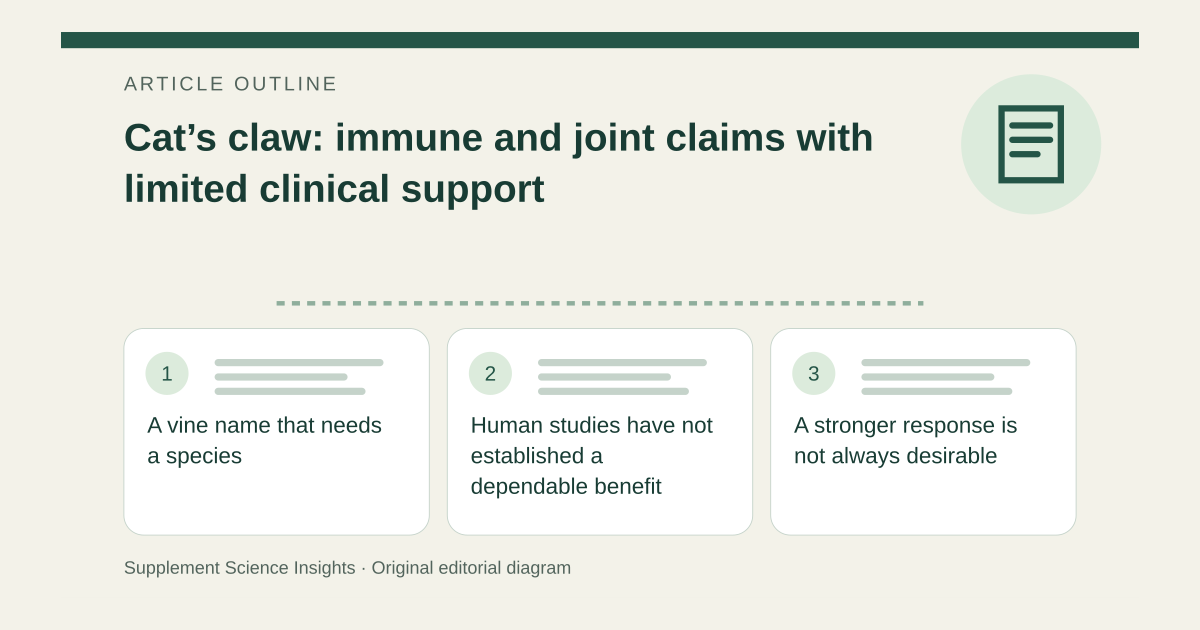
A vine name that needs a species
Cat’s claw usually refers to Uncaria tomentosa or Uncaria guianensis, vines from tropical parts of the Americas. It is not devil’s claw or cat’s foot. Common names can create a misleading sense of equivalence when the plants and evidence are different. [1]
A useful record identifies the Latin name, plant part and extract. A product with an attractive traditional-use story still needs that basic identity before research can be matched to it. [1]
Human studies have not established a dependable benefit
NCCIH finds no conclusive human evidence supporting cat’s claw for a health purpose. Some studies have explored inflammatory or joint-related conditions, but small samples and weak methods limit interpretation. A positive result should retain those limitations rather than becoming a general treatment claim. [1]
For joint research, ask whether the outcome was pain, physical function, swelling or a laboratory marker. These are related questions, but one favorable finding does not establish improvement in all of them. [1]
A stronger response is not always desirable
Immune-support language can obscure the actual goal. Reducing infections, changing a cytokine concentration and stimulating immune-cell activity are not interchangeable outcomes. In autoimmune disease or immunosuppressive treatment, increasing immune activity may be undesirable.
A useful claim should identify the population and the measured outcome. If neither is clear, a mechanism-based explanation cannot establish that the product is appropriate for the reader.
A supplement containing several vines or other herbs creates another attribution problem: even a favorable result for the mixture would not identify which ingredient contributed, or whether the combination matters.
Bleeding, medicines and pregnancy require caution
Cat’s claw may increase immune activity and could worsen autoimmune symptoms. It may also slow clotting, with particular relevance around surgery. Potential interactions with anticoagulants, antiplatelet medicines and blood-pressure medicines require discussion with a clinician or pharmacist. [1]
Some evidence suggests pregnancy use is unsafe, and breastfeeding information is limited. Short-term oral tolerability does not establish that every preparation is safe indefinitely or when combined with other products. [1]
Similar names do not form a valid comparison
Imagine two fictional labels: A names Uncaria tomentosa root extract; B says “devil’s claw root.” Even if both list 300 mg, they are not the same botanical. A comparison that puts both amounts in a cat’s-claw column would be incorrect.
If a third label uses only “cat’s claw” without a species or plant part, retain that missing information. The exercise identifies what needs clarification, not which herb should be used for pain.
| Fictional label | Identity conclusion |
|---|---|
| Uncaria tomentosa | Cat’s-claw species identified |
| Devil’s claw | Different botanical |
| Common name only | Species and preparation unresolved |
Make the claim narrower before judging it
Ask which species and preparation were tested, whether the study isolated the ingredient and what benefit actually occurred. A broad claim about inflammation is not enough. This overview summarizes the evidence limits and does not offer a treatment or a product recommendation.
Sources for this article
- NCCIH — Cat’s claw: Usefulness and Safety
Source consulted: 2026-09-17. This is a reference resource, not a claim that we conducted the studies or tested a product.