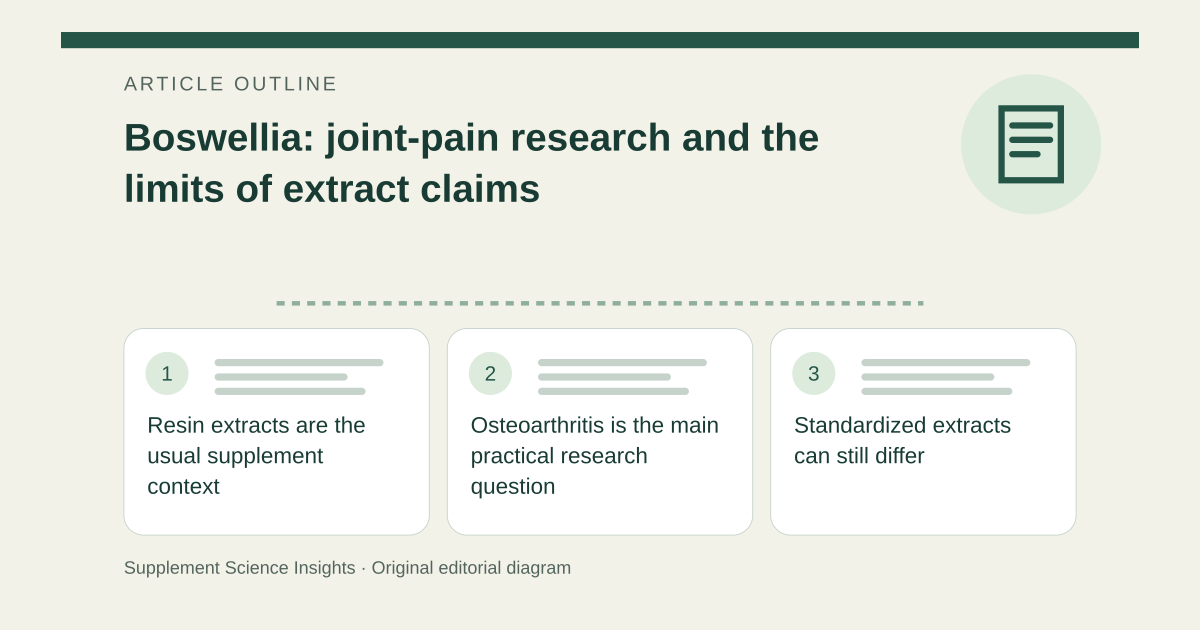
Resin extracts are the usual supplement context
Boswellia serrata is a tree whose resin is used in extracts. Frankincense is a broader name associated with resin from Boswellia species and with aromatherapy products. An oral resin extract, a topical product and an essential oil are different interventions. [1]
Do not transfer oral-study findings to an oil simply because both use the word frankincense. Botanical species, plant material, extraction and route belong in the comparison. [1]
Osteoarthritis is the main practical research question
NCCIH describes small studies suggesting that oral boswellia may reduce osteoarthritis pain or inflammation, but judges the overall evidence insufficient because larger, better-quality studies are needed. A positive result is a reason for further investigation, not proof that every extract works. [1]
Pain and function should be reported separately from a laboratory marker. A useful change would help someone do an activity or reduce a meaningful symptom, rather than merely move a number without a clear clinical interpretation. [1]
Standardized extracts can still differ
A label may identify total boswellic acids or a particular fraction. Different marker declarations are not interchangeable, and equal percentages do not establish equal amounts unless the extract mass is also known.
A proprietary preparation studied in a trial should retain its identity in the evidence summary. A generic resin powder cannot automatically borrow the finding. Conversely, a brand's study citation does not independently verify the contents of every current batch.
Other treatment plans should remain intact
Short clinical studies have generally found some boswellia extracts tolerable, but that does not establish long-term safety for all preparations. Medicinal-dose pregnancy and breastfeeding information is limited. People taking medicines should discuss the full product with their clinician. [1]
Asthma and cancer claims require particular care: boswellia should not replace prescribed asthma treatment, and it is not an established cancer cure. Preliminary research in those settings does not justify interrupting effective care. [1]
Read the marker and its denominator
Imagine Extract A declares 200 mg standardized to 30 percent total boswellic acids. The declared marker quantity is 60 mg. Extract B states 200 mg resin powder without a marker percentage; it cannot be assigned the same 60 mg.
This calculation describes a label claim. It does not establish equivalent absorption, the amount of any individual boswellic acid or a clinical dose. Keep those unanswered questions beside the arithmetic.
| Fictional preparation | Declared marker |
|---|---|
| 200 mg extract at 30% | 60 mg total boswellic acids |
| 200 mg resin powder | Marker amount unknown |
A measured outcome is more useful than “anti-inflammatory”
For joint discomfort, ask whether the study measured pain, walking, daily function and adverse effects in people with a relevant diagnosis. A broad anti-inflammatory phrase cannot answer those questions. This overview supports careful interpretation rather than a product ranking. Record whether participants continued analgesics and whether rescue-medicine use changed; symptom scores alone may not describe the full result.
Sources for this article
- NCCIH — Boswellia: Usefulness and Safety
Source consulted: 2026-09-17. This is a reference resource, not a claim that we conducted the studies or tested a product.