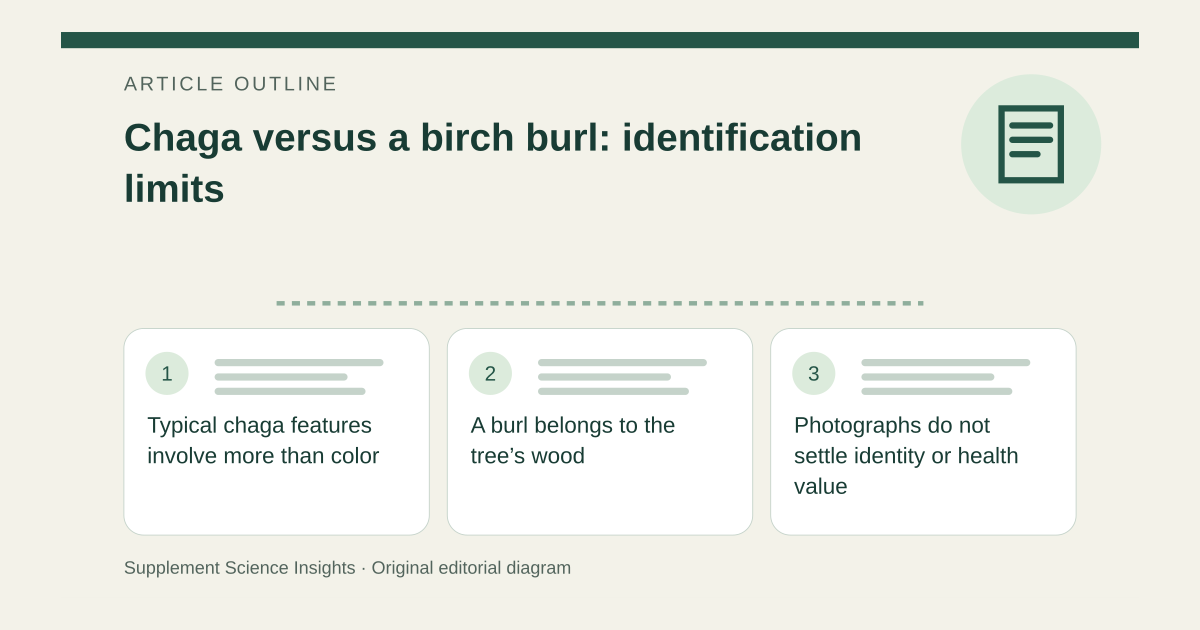
Typical chaga features involve more than color
University of Minnesota describes Inonotus obliquus growths as rough, cracked black knobs or cones, often near an old wound or branch stub. The interior is yellow-brown to rust-brown. Associated decay can weaken the tree, so the finding also has tree-health implications. [1]
A burl belongs to the tree’s wood
University of Maryland describes burls as rounded woody swellings, sometimes bearing sprouts, with unusual grain. Their causes vary or remain uncertain. Removing a burl can harm the tree; it is not a harmless way to investigate a possible mushroom. [2]
Photographs do not settle identity or health value
Host tree, growth structure and expert examination matter. Even correctly identified chaga is not established as a safe, effective treatment. MSK describes kidney-injury reports and unproven human benefits, which a foraging identification cannot resolve. [3][1]
Document the find before disturbing it
Imagine a dark swelling appears on a birch. Photograph the whole tree and growth and ask a local extension specialist or qualified mycologist for identification. Avoid tasting it or cutting into the tree based on an internet comparison. [2][1]
| Observation | Interpretation |
|---|---|
| Black cracked growth | Compatible feature, not confirmation |
| Woody swelling with grain | Burl possibility |
| On a birch | Host alone insufficient |
| Confirmed chaga | Not proof of clinical safety |
Sources for this article
- What's wrong with my plant? : Garden : University of Minnesota Extension
Source consulted: 2026-09-21. This is a reference resource, not a claim that we conducted the studies or tested a product. - Burls | University of Maryland Extension
Source consulted: 2026-09-21. This is a reference resource, not a claim that we conducted the studies or tested a product. - Chaga Mushroom | Memorial Sloan Kettering Cancer Center
Source consulted: 2026-09-21. This is a reference resource, not a claim that we conducted the studies or tested a product.