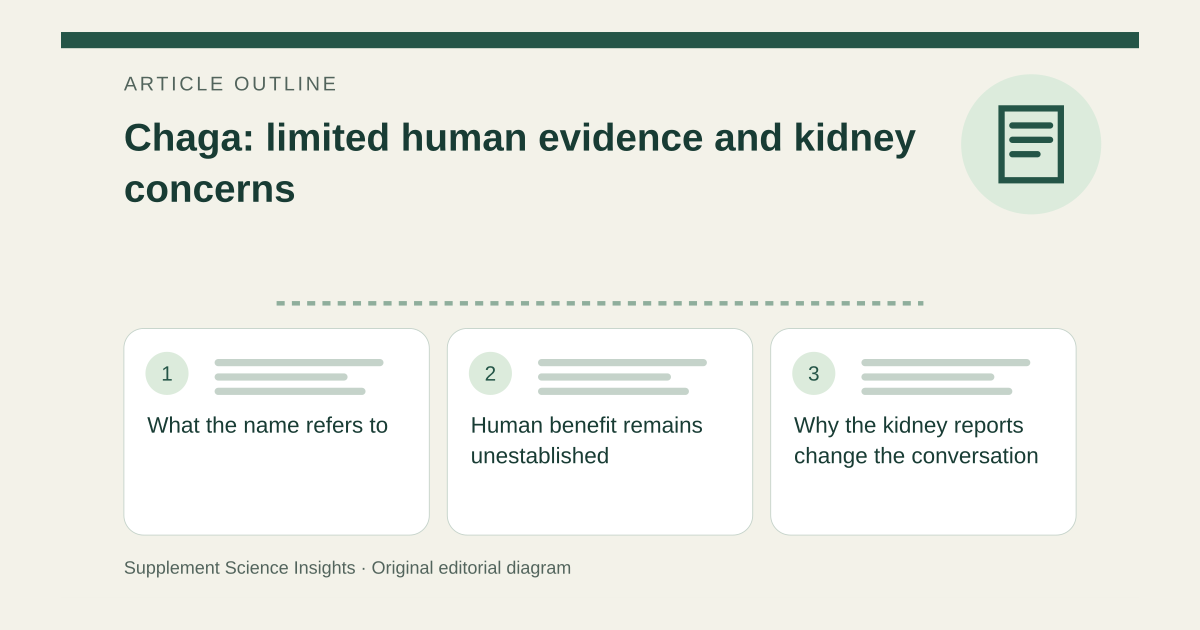
What the name refers to
Chaga is a fungus associated with birch trees. MSK describes the medicinal conk as including fungal mycelium and material from the host tree. Tea and powdered preparations appear in traditional use, but that history does not tell us whether a particular supplement has a favorable balance of benefits and harms. [1]
Human benefit remains unestablished
The MSK monograph describes numerous laboratory and animal experiments but states that clinical evaluation of chaga’s safety and efficacy is lacking. Findings in cancer cells or animal exercise models therefore should not be presented as proof of cancer treatment, improved stamina or protection from illness in people. [1]
Why the kidney reports change the conversation
MSK reports cases of oxalate-related kidney injury after substantial or prolonged chaga powder intake, including cases requiring dialysis. Case reports cannot tell us the overall likelihood of harm or identify a universally safe dose. They can reveal serious events that a broad description such as “natural antioxidant” leaves out. [1]
Separate absence of proof from reassurance
There are two different mistakes to avoid. One is to assume a promising laboratory effect will become a useful clinical treatment. The other is to assume a product is harmless because large human trials have not documented a problem. Missing research leaves both benefit and harm questions open.
Suppose an advertisement supplies ten laboratory references and no controlled human trial of its product. Counting the references does not close that gap. The relevant question is what type of evidence those references contain. Several demonstrations of a mechanism still do not measure how a person feels, functions or fares over time.
The same care applies to a reassuring anecdote. Someone reporting no noticeable problem after using chaga gives information about that experience. It does not establish safety for another person, another preparation or a longer period of use.
| Information presented | What it establishes | What remains unanswered |
|---|---|---|
| Cancer cells respond in a laboratory | An experimental observation | Treatment benefit in a patient |
| A kidney injury case is reported | A serious safety signal | How often it occurs |
| A user reports feeling well | That person’s account | Safety for another person |
Discuss kidney and medication risks
People with kidney concerns should bring the kidney injury reports into a clinician discussion before considering chaga. MSK also flags possible interactions with anticoagulant, antiplatelet and glucose-lowering drugs, while noting uncertain clinical relevance. These concerns do not supply a dosing formula. [1]
A reasonable decision can be to pass
You do not need to choose between competing chaga products before deciding whether there is a convincing reason to use one. Start with the intended benefit. If the supporting evidence does not answer that question in people, declining the purchase is a complete decision. This article provides no product pick or self-treatment regimen.
Sources for this article
- Memorial Sloan Kettering — Chaga Mushroom
Source consulted: 2026-09-17. This is a reference resource, not a claim that we conducted the studies or tested a product.