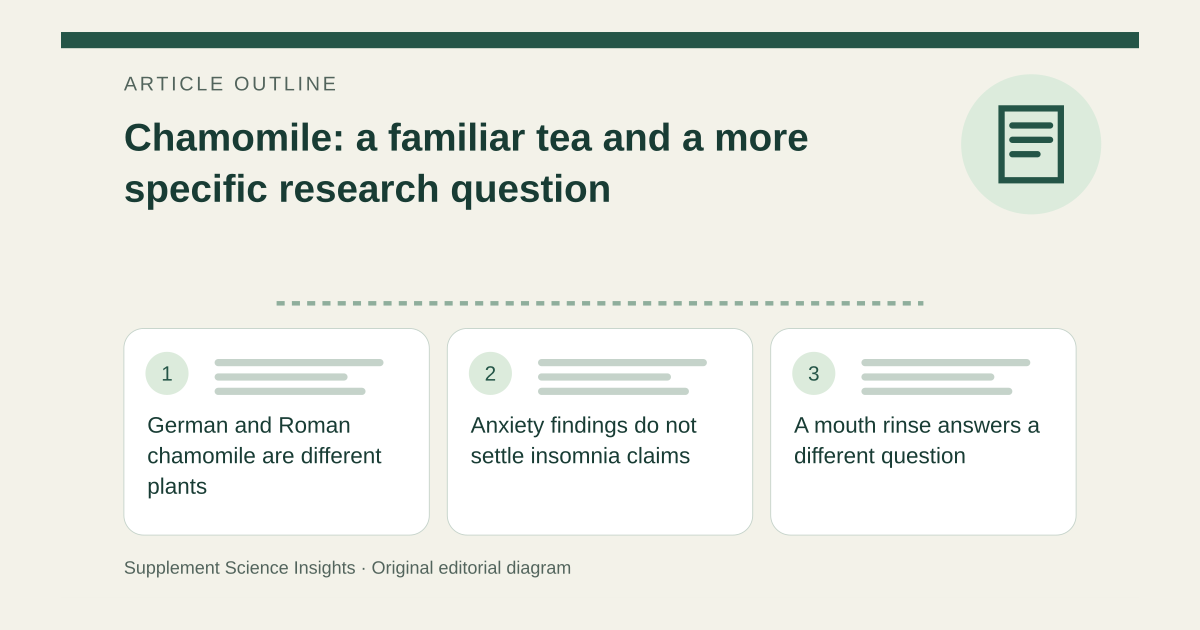
German and Roman chamomile are different plants
Research summaries often focus on German chamomile, commonly identified as Matricaria recutita or Matricaria chamomilla. Roman chamomile is a different botanical. Tea, concentrated oral extracts and topical preparations also differ in composition and route. [1]
A study of a standardized capsule therefore does not establish that an unspecified cup of tea delivers the same intervention. The familiar plant name should be the beginning of identification, not the end. [1]
Anxiety findings do not settle insomnia claims
NCCIH describes preliminary evidence for some anxiety-related outcomes, but not enough reliable evidence to rate chamomile as a broadly useful treatment. Information on insomnia is sparse. Studies of a combination containing chamomile cannot establish the effect of chamomile alone. [1]
Feeling relaxed after a warm drink and meeting a clinical insomnia endpoint are different experiences. A sleep claim needs to specify whether it concerns sleep onset, awakenings, total sleep or next-day function, rather than treating relaxation as proof of all four. [1]
A mouth rinse answers a different question
Small studies have considered chamomile-containing mouthwashes for treatment-related oral irritation. That route and clinical setting differ from swallowing a supplement for digestive or sleep symptoms. [1]
Keep co-treatments visible and do not turn a local mouth-rinse finding into a systemic benefit. A person undergoing cancer treatment should discuss any such product with the care team instead of adapting an oral-supplement label for another use. [1]
For a sleep study, the comparison beverage or placebo matters too. A bedtime routine may change alongside the drink, so an uncontrolled account cannot separate the ingredient from the surrounding routine. [1]
Allergy and interactions can matter despite food familiarity
Chamomile can cause allergic reactions, occasionally severe, particularly in people sensitive to related plants such as ragweed. Interactions with warfarin and some medicines metabolized by the liver have been reported; sedative interactions are also a concern. Hormone-sensitive conditions warrant discussion with the treating team. [1]
Pregnancy and breastfeeding evidence is limited. A tea's ordinary use does not establish that concentrated extracts, eye applications or multi-herb products are suitable in every setting. [1]
A tea bag and a capsule are not dose equivalents
Imagine a tea bag contains 1.5 g dried flowers and a capsule contains 200 mg extract. The larger printed tea-bag mass does not prove a larger absorbed exposure. Extraction during brewing and commercial extract composition are different and incompletely described by those two numbers.
Record preparation, species and serving instead of inventing a conversion. This fictional example does not identify an effective anxiety or sleep dose.
| Fictional preparation | Comparison limit |
|---|---|
| 1.5 g dried-flower tea bag | Brewing extraction not specified |
| 200 mg extract capsule | Composition needed |
| Equal botanical name | Does not establish equivalent exposure |
Use a precise purpose and preparation
An occasional beverage, an anxiety-treatment claim and a mouth-care intervention should be assessed separately. This reference explains those distinctions without endorsing chamomile for a diagnosed condition or treating a bedtime ritual as a clinical trial.
Sources for this article
- NCCIH — Chamomile: Usefulness and Safety
Source consulted: 2026-09-17. This is a reference resource, not a claim that we conducted the studies or tested a product.