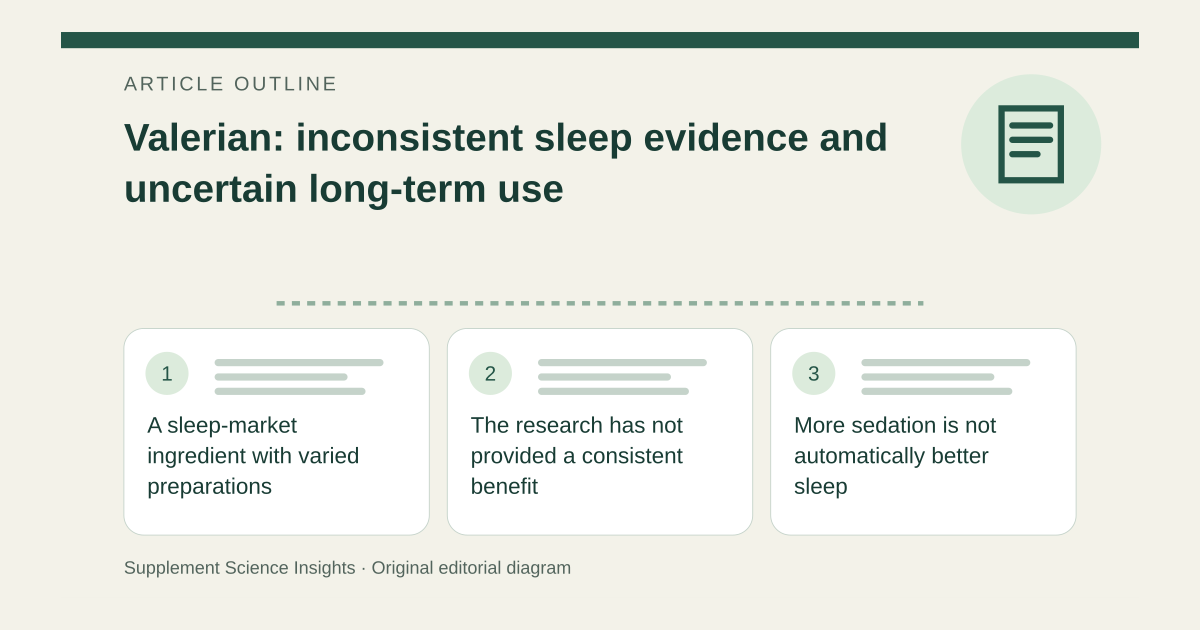
A sleep-market ingredient with varied preparations
Valerian usually refers to Valeriana officinalis and is sold in teas, extracts and multi-herb sleep products. These preparations differ, and a study of one cannot automatically establish benefit from another. The whole formula matters when other sedating ingredients are included. [1]
A sleep claim should specify whether it concerns falling asleep, staying asleep, total duration or daytime functioning. Those outcomes can move in different directions, and the word sleep alone does not identify what a study established. [1]
The research has not provided a consistent benefit
NCCIH describes inconsistent evidence for sleep problems and insufficient evidence to determine usefulness for other health conditions. Its summary notes that the American Academy of Sleep Medicine recommended against valerian for chronic insomnia in its cited clinical guideline. [1]
A few small studies have explored menopausal symptoms, but firm conclusions cannot be drawn. A product's longstanding use or calming reputation should not be allowed to override the uncertainty of the clinical evidence. [1]
More sedation is not automatically better sleep
A useful assessment includes how someone functions the next day, not simply whether they feel sleepy after taking a product. A study that measures only a subjective sleep score cannot supply an unmeasured driving, work or cognitive outcome.
Also ask whether participants had chronic insomnia or occasional poor sleep, how long the study lasted and what happened in the placebo group. A change during a short experiment does not establish sustained benefit after months of use or after stopping the preparation.
Long-term use introduces additional uncertainty
Short-term use has generally been tolerated, but reported effects include headache, stomach upset, mental dullness, excitability and vivid dreams. Long-term safety is unknown. Withdrawal symptoms have been reported after abrupt discontinuation following chronic use, so ongoing use should be discussed with a clinician rather than changed through a generic online regimen. [1]
Valerian should not be combined with alcohol or sedatives. Rare liver-injury reports, often involving combinations, do not establish a simple causal estimate but deserve attention. Pregnancy and breastfeeding information is limited. [1]
A rating scale cannot answer an unmeasured question
Imagine a fictional trial reports a one-point improvement on a sleep questionnaire but does not measure next-day alertness. It cannot establish that participants worked better, drove more safely or felt less fatigued.
The significance of one point also depends on the scale, uncertainty and comparator. The invented example does not represent an expected valerian effect or identify a useful dose.
| Hypothetical measurement | Interpretation |
|---|---|
| Sleep questionnaire changed | Subjective score result |
| Daytime alertness unmeasured | No functional conclusion |
| Short study | Long-term benefit unresolved |
Keep the sleep problem and evidence specific
This page does not recommend valerian for chronic insomnia or provide a discontinuation schedule. A careful comparison includes uncertain benefit, other sedating exposures and the limits of long-term safety data. Persistent sleep problems deserve assessment beyond a supplement category.
Sources for this article
- NCCIH — Valerian: Usefulness and Safety
Source consulted: 2026-09-17. This is a reference resource, not a claim that we conducted the studies or tested a product.