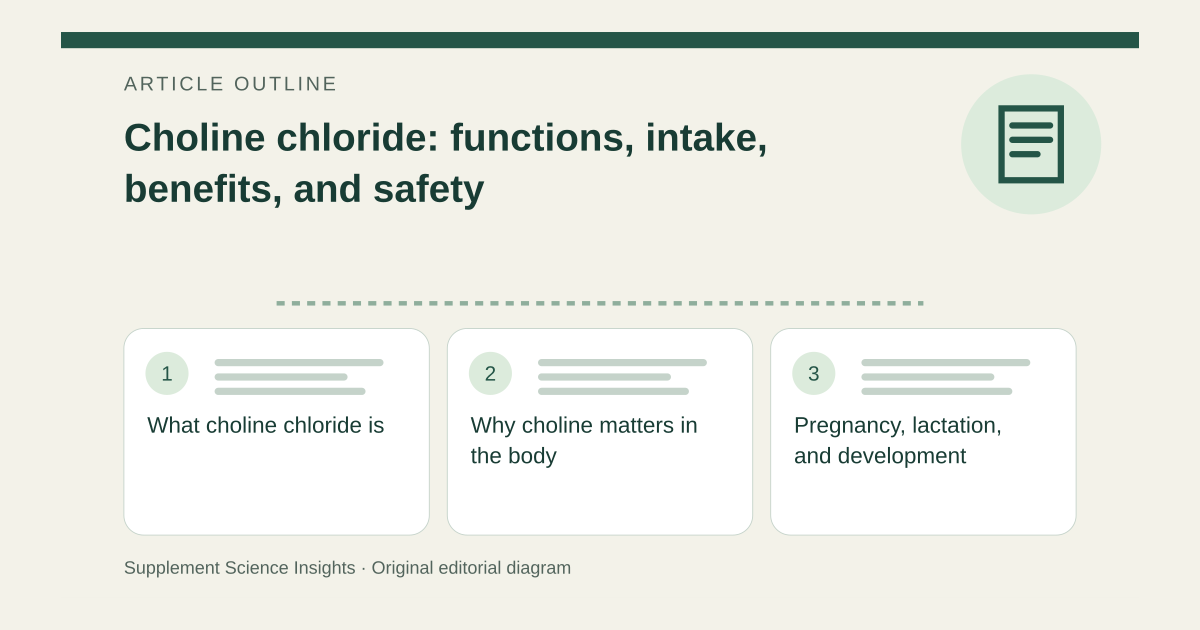
What choline chloride is
Choline chloride is the chloride salt of choline, an essential nutrient required for normal human physiology. Choline itself is a water-soluble organic compound often discussed alongside the B vitamins even though it is not formally classified as one. The body can synthesize some choline in the liver, mainly through production of phosphatidylcholine, but endogenous synthesis is generally not enough to meet physiological needs, so food and sometimes supplements provide the remainder. [1][2]
In supplements, choline can appear in several chemical forms. Choline chloride is one of the simplest and most water-soluble forms and supplies the choline ion after ingestion. That distinction matters: evidence establishing that humans need choline does not automatically prove that choline chloride is superior to phosphatidylcholine, citicoline, alpha-GPC, or other supplemental sources. Form-specific claims require form-specific evidence. [1][2]
Why choline matters in the body
A major role of choline is structural. It is used to make phosphatidylcholine and sphingomyelin, phospholipids that are important components of cell membranes. These compounds help maintain membrane integrity and participate in cellular signaling and lipid transport. [1]
Choline is also the precursor for acetylcholine, a neurotransmitter involved in muscle activation, memory, attention, and other nervous-system functions. In addition, choline contributes methyl groups through its metabolite betaine. Those methyl groups participate in one-carbon metabolism, including reactions involved in gene regulation and the handling of homocysteine. [1]
The liver is especially sensitive to inadequate choline because phosphatidylcholine is needed to package and export lipids. When choline intake is insufficient, fat can accumulate in the liver and markers of liver or muscle injury can rise. These observations are part of the evidence supporting choline as an essential nutrient. [1]
Pregnancy, lactation, and development
Choline requirements increase during pregnancy and lactation. The nutrient is involved in fetal growth, cell-membrane formation, neurotransmitter synthesis, and methylation pathways during development. Research has therefore examined maternal choline intake in relation to fetal brain development and later cognitive outcomes. [1]
The biological rationale is strong, but developmental claims should still be stated carefully. Human studies differ in dose, timing, baseline diet, and measured outcomes. It is more defensible to say that adequate choline intake is important during pregnancy than to promise a particular cognitive benefit from a choline-chloride supplement. [1]
How much choline people need and where it comes from
The U.S. National Academies established Adequate Intake values because available evidence was not sufficient to set a Recommended Dietary Allowance. For adults, the AI is 550 mg per day for men and 425 mg per day for women. The AI is 450 mg per day during pregnancy and 550 mg per day during lactation. Needs vary across childhood and adolescence. [1]
Choline is present in many foods, including eggs, meat, poultry, fish, dairy foods, soybeans, some beans, and certain vegetables. Dietary intake should therefore be considered before deciding whether supplementation is useful. National intake data indicate that many people consume less than the AI, although overt deficiency in generally healthy people is uncommon. [1]
Supplement labels may list the amount of choline supplied rather than the total weight of the choline-containing compound. When comparing products, the meaningful figure is the amount of choline delivered per serving, together with the chemical form and serving size. [1]
What choline chloride can and cannot be assumed to do
Choline chloride can be used to increase choline intake when diet alone does not provide enough or when a clinician recommends supplementation. Because it is water soluble and provides choline directly, it is a straightforward nutrient source. However, statements about memory enhancement, liver treatment, athletic performance, or other therapeutic outcomes should not be inferred merely from choline being essential. [1]
A useful way to judge a claim is to ask whether the human trial actually used choline chloride, how much choline it supplied, what the participants’ baseline choline status was, and whether the study measured a clinically meaningful endpoint. Research on choline biology is relevant background, but it is not interchangeable with evidence that a specific supplemental form improves a specific condition. [1]
Safety, upper limits, and high intake
Choline is necessary, but very high intake can cause adverse effects. Reported effects of excessive intake include a fishy body odor, vomiting, increased sweating and salivation, low blood pressure, and liver toxicity. The adult Tolerable Upper Intake Level is 3,500 mg of choline per day from food and supplements combined; lower limits apply to younger age groups. [1]
Research has also examined trimethylamine N-oxide, or TMAO, a metabolite that can be produced when gut microbes metabolize choline and related compounds. Higher blood TMAO levels have been associated with cardiovascular risk in observational research, but the clinical meaning of increasing choline intake through supplements is not settled by that association alone. This is an area where mechanistic and observational findings should not be overstated. [1]
People who are pregnant or breastfeeding, have liver or kidney disease, take multiple medications, or are considering high-dose supplementation should discuss the dose and purpose with a qualified clinician. The goal is adequate intake, not simply the highest possible dose. [1]
How to evaluate a choline supplement
For a practical comparison, record the choline form, elemental or delivered choline per serving, serving size, other active ingredients, third-party quality testing when available, and the reason the product is being used. If a product makes a specific health claim, trace that claim to human evidence involving the same form and a reasonably comparable dose. [1][2]
This approach keeps two questions separate: whether choline is an essential nutrient, which is well established, and whether a particular choline-chloride product has demonstrated a particular benefit. Keeping those questions separate produces a more accurate supplement decision. [1][2]
Sources for this article
- NIH Office of Dietary Supplements — Choline: Health Professional Fact Sheet
Source consulted: 2026-09-16. This is a reference resource, not a claim that we conducted the studies or tested a product. - PubChem — Choline Chloride (CID 6209)
Source consulted: 2026-09-16. This is a reference resource, not a claim that we conducted the studies or tested a product. - ScienceInsights — What Is Choline Chloride and What Are Its Benefits?
Source consulted: 2026-09-16. This is a reference resource, not a claim that we conducted the studies or tested a product.
Considering a supplement?
Ingredient evidence alone does not establish which retail product is suitable. No single featured product is recommended for this article.
No verified exact-form human supplement and no approved broader-form substitution. Do not treat citicoline, alpha-GPC or phosphatidylcholine as choline chloride.
Compare formulations → · How we select products