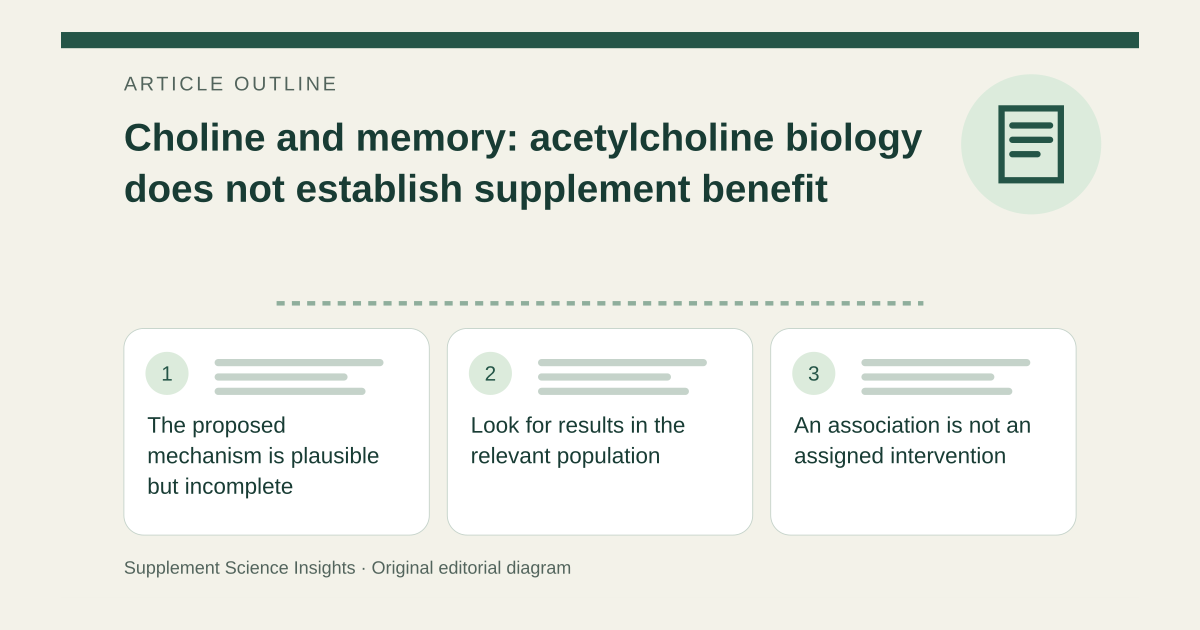
The proposed mechanism is plausible but incomplete
Choline is a precursor of acetylcholine and contributes to neuronal membranes. These roles explain research interest in cognition. They do not establish that increasing intake improves memory regardless of baseline nutrition, age or diagnosis. [1]
ODS describes observational studies linking higher intake or blood choline with some better cognitive measures. Such associations can reflect differences in diet, health or other factors. They do not isolate the effect of giving a supplement. [1]
Look for results in the relevant population
The fact sheet discusses some small positive intervention studies but also a 2015 review finding no clear cognitive improvement in healthy adults. An older review of lecithin trials found no clear clinical benefit for Alzheimer’s disease or Parkinsonian dementia. These findings should not be generalized into a ranking of all choline compounds. [1]
The cited ODS page was updated in June 2022 and is not a current systematic review of every newer trial. It supports caution about converting a mechanism into a promise. New or worsening memory problems deserve assessment rather than an assumed neurotransmitter deficiency. [1]
An association is not an assigned intervention
Imagine people with higher dietary choline score better on a memory test. If the study did not assign supplementation, it cannot tell whether a capsule would reproduce the difference. The intervention question remains separate.
| Item | Interpretation |
|---|---|
| Diet–memory association | Observational finding |
| Randomized supplement comparison | Tests an intervention |
| Dementia treatment claim | Requires clinical evidence in that condition |
Sources for this article
- NIH ODS: Choline — Health Professional Fact Sheet
Source consulted: 2026-09-17. This is a reference resource, not a claim that we conducted the studies or tested a product.