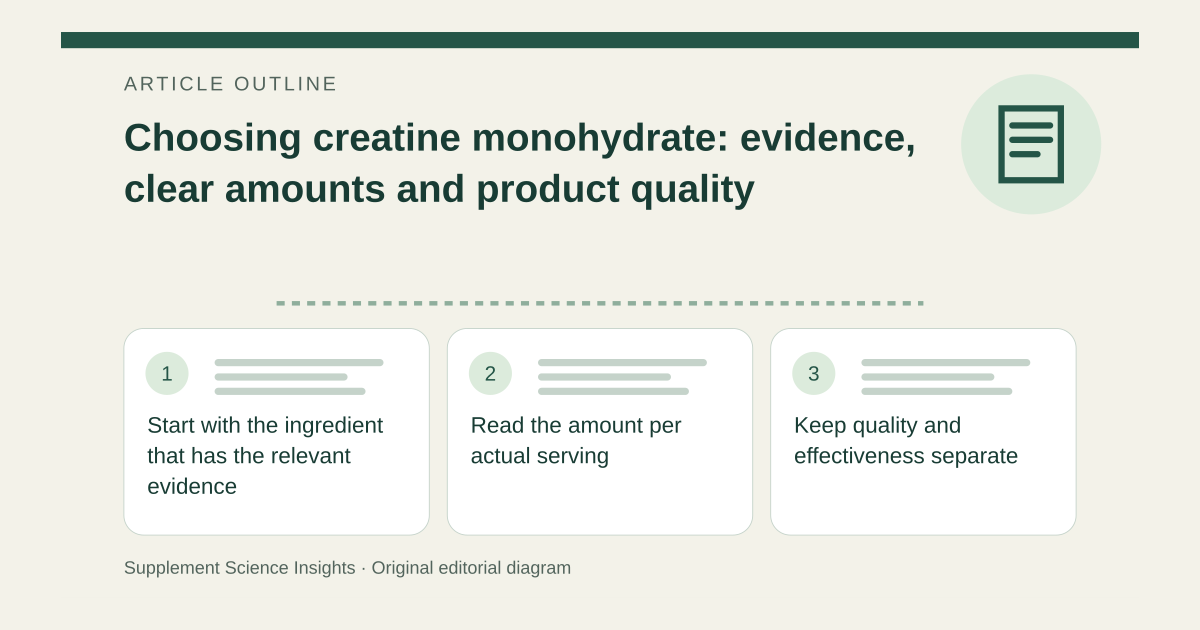
Start with the ingredient that has the relevant evidence
NIH ODS describes evidence for creatine in repeated high-intensity activity and identifies monohydrate as the most widely studied form. A claim about a different salt, faster dissolving powder or a premium delivery format is not by itself proof of more muscle growth. [1]
Read the amount per actual serving
A scoop can contain creatine plus flavors or other ingredients. Its total weight is not necessarily the creatine amount. Capsules and gummies require the number of units per serving to be considered. Compare equivalent declared amounts before comparing convenience or price. [2][1]
Keep quality and effectiveness separate
Credible quality documentation can help assess identity, purity and composition. It does not prove that a product improves your training result or that a larger amount is appropriate. This article has not independently tested retail brands and cannot turn a marketing seal into a clinical head-to-head result. [3][1]
An independently listed creatine example
A directory check on September 25, 2026 found Thorne Creatine in NSF Certified for Sport: unflavored powder, 450 g and 900 g packages, 5 g scoop; specific certified lots are listed. This is an independently listed quality-check example, not a clinical winner. It does not certify another brand, a different pack or flavor, or an Amazon seller. Recheck the exact entry and your lot before purchase. [4][5]
Choose a format that supports consistent, transparent use
Imagine two products supply the same declared monohydrate amount, but one hides it within a complex blend. The simpler declaration is easier to evaluate. Base the decision on ingredient evidence, tolerability and verifiable information, while keeping training and adequate food central. [1][3]
| Check | Avoid assuming |
|---|---|
| Declared monohydrate amount | Scoop weight equals creatine weight |
| Format | Convenience proves greater efficacy |
| Quality documentation | Testing proves a personal benefit |
Sources for this article
- Dietary Supplements for Exercise and Athletic Performance - Health Professional Fact Sheet
Source consulted: 2026-09-21. This is a reference resource, not a claim that we conducted the studies or tested a product. - How to Understand and Use the Nutrition Facts Label | FDA
Source consulted: 2026-09-21. This is a reference resource, not a claim that we conducted the studies or tested a product. - Dietary Supplements: What You Need to Know
Source consulted: 2026-09-21. This is a reference resource, not a claim that we conducted the studies or tested a product. - NSF Certified for Sport directory: Thorne Creatine
Source consulted: 2026-09-25. This is a reference resource, not a claim that we conducted the studies or tested a product. - NSF Certified for Sport: what the mark means
Source consulted: 2026-09-25. This is a reference resource, not a claim that we conducted the studies or tested a product.