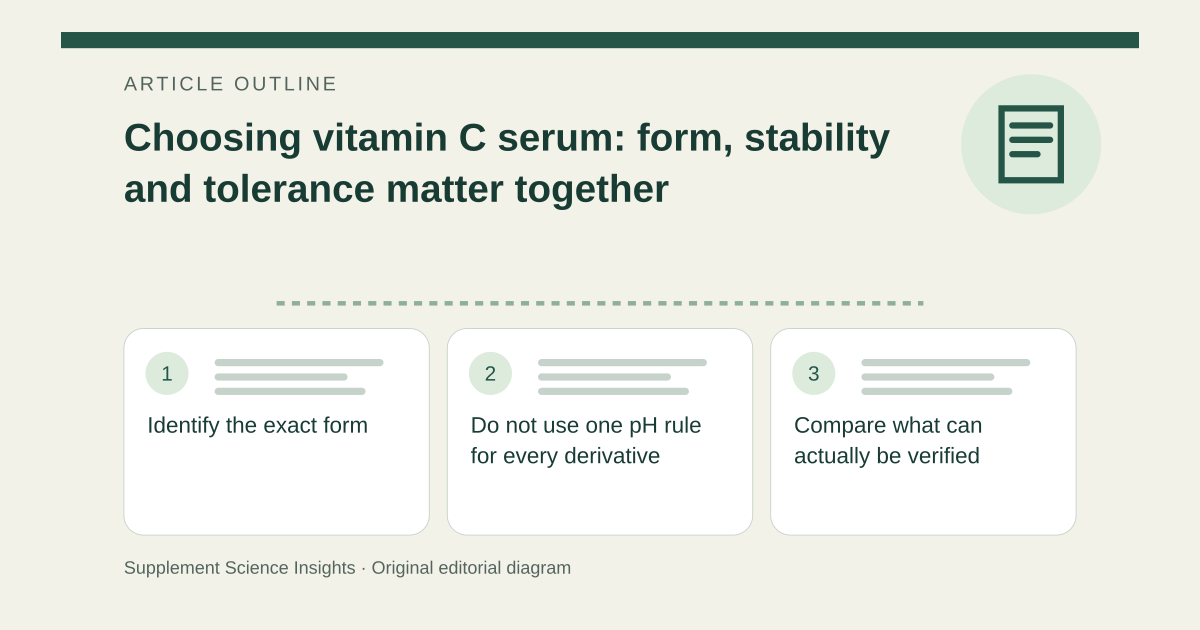
Identify the exact form
A label can list ascorbic acid or a chemically modified derivative. These forms differ in stability, delivery and the need for conversion within skin. Evidence for one should not be transferred automatically to another, especially when the vehicle and concentration also differ. [1]
Do not use one pH rule for every derivative
Acidity influences delivery of L-ascorbic acid, but the formulation requirements of derivatives can differ. The review’s discussion of acidic ascorbic-acid preparations is not a home recipe or instruction to adjust a purchased serum’s pH. More acidic or more concentrated is not automatically better tolerated or more effective. [2]
Compare what can actually be verified
Imagine one product declares a high percentage but provides little stability information, while another specifies its form, use period and directions. Evaluate the full information and your skin’s response rather than ranking only the largest number. A small-area test can help identify a reaction, but it does not prove clinical effectiveness. [3][1]
| Example | Interpretation |
|---|---|
| Ingredient form | Defines the formulation question |
| Percentage alone | Incomplete comparison |
| Tolerated small-area test | Not an efficacy study |
Sources for this article
- The Roles of Vitamin C in Skin Health - PMC
Source consulted: 2026-09-20. This is a reference resource, not a claim that we conducted the studies or tested a product. - Topical Vitamin C and the Skin: Mechanisms of Action and Clinical Applications - PMC
Source consulted: 2026-09-20. This is a reference resource, not a claim that we conducted the studies or tested a product. - How to test skin care products
Source consulted: 2026-09-20. This is a reference resource, not a claim that we conducted the studies or tested a product.