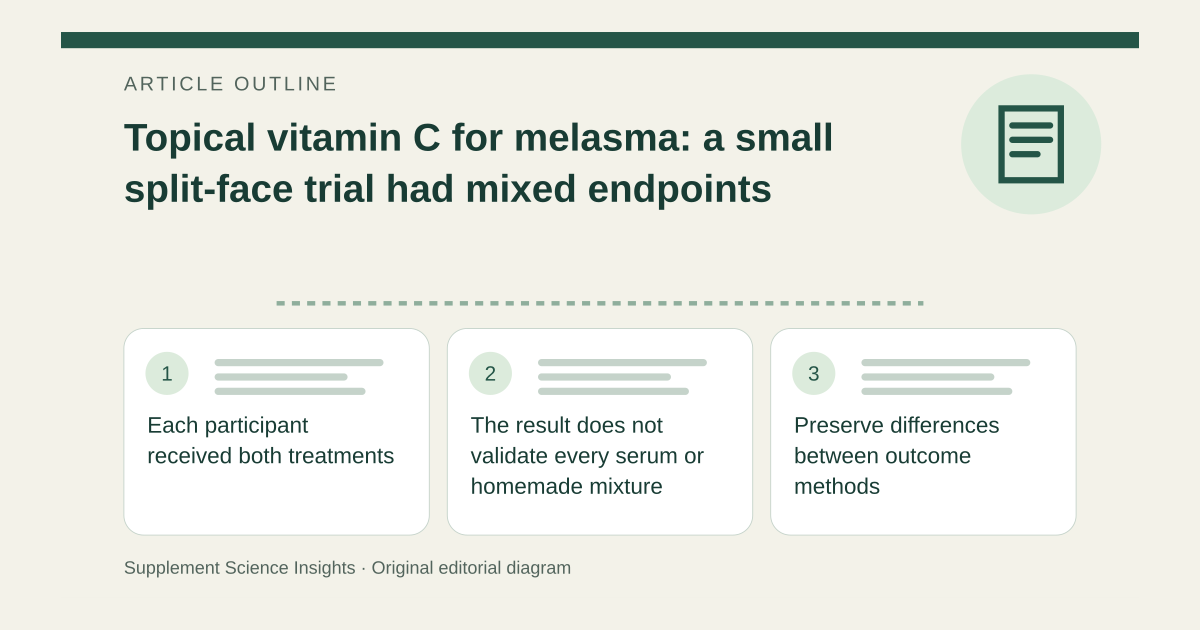
Each participant received both treatments
Women with melasma applied one cream to each side of the face for 16 weeks, with randomized side assignment. Daily sunscreen was part of the regimen. [1]
Participants rated improvement more favorably on the hydroquinone side. Colorimetry did not show a statistically significant difference. Reported side effects were more frequent with hydroquinone than with the tested ascorbic acid cream. [1]
The result does not validate every serum or homemade mixture
Sixteen participants provide limited evidence, and the study does not establish long-term recurrence control. A 5% formulated cream is not interchangeable with a different derivative, stronger serum or crushed oral tablets. [1]
Funding and conflicts were not established from the abstract. The findings concern diagnosed melasma rather than every cause of dark spots. The lower adverse-event count in one small study does not mean that topical vitamin C cannot irritate skin or that sunscreen can be omitted. [1]
Preserve differences between outcome methods
Imagine users prefer one side’s appearance while an instrument finds no significant difference. Both findings belong in the interpretation; neither should be silently substituted for the other.
| Detail | Interpretation |
|---|---|
| 16 women | Small sample |
| Daily sunscreen | Part of both treatments |
| Different outcome methods | Different findings |
Sources for this article
- A double-blind randomized trial of 5% ascorbic acid vs. 4% hydroquinone in melasma - PubMed
Source consulted: 2026-09-19. This is a reference resource, not a claim that we conducted the studies or tested a product.