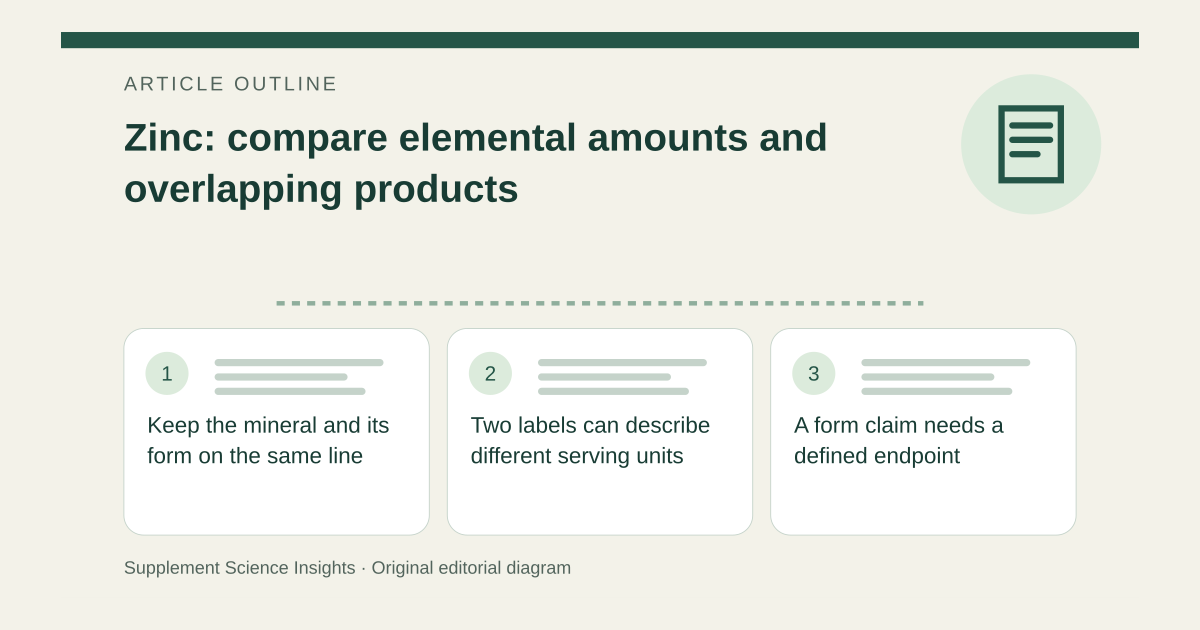
Keep the mineral and its form on the same line
Zinc supplements use forms such as sulfate, acetate and gluconate. NIH ODS explains that Supplement Facts declares elemental zinc rather than the weight of the entire zinc-containing compound. Copy the zinc amount, unit, serving size and stated form together. [1]
A comparison becomes ambiguous when one number refers to a compound and another refers to the mineral. If the packaging does not make that distinction clear, retain the uncertainty and request the complete label before ranking the products. [1]
Two labels can describe different serving units
In this invented comparison, Label A declares 15 mg zinc per two capsules. Label B declares 10 mg per one tablet. A complete serving of A therefore declares more zinc than a complete serving of B, although an individual capsule of A accounts for 7.5 mg by arithmetic.
These quantities are teaching examples, not suggested intakes. The calculation does not tell someone to divide a serving or choose the higher amount. Keep the manufacturer’s directions separate from the comparison worksheet; neither label establishes what a particular person needs.
| Field | Label A | Label B |
|---|---|---|
| Serving | 2 capsules | 1 tablet |
| Zinc per serving | 15 mg | 10 mg |
| Zinc per individual unit | 7.5 mg by arithmetic | 10 mg |
| Personal suitability | Unresolved | Unresolved |
A form claim needs a defined endpoint
When a package emphasizes a chelate or another preparation, write down the actual claim being made. Is it a statement about composition, an absorption measurement, tolerability or a clinical outcome? These are different questions.
Ask whether the cited evidence evaluates the exact preparation, population and outcome. A familiar ingredient name or a favorable laboratory measurement is not enough to establish that the retail product prevents an illness. This article does not identify a universally superior zinc form.
Include duration and the rest of the supplement list
Excess zinc can cause gastrointestinal effects. Sustained high intake can interfere with copper absorption. ODS also identifies interactions with certain antibiotics and penicillamine; some diuretics affect zinc losses. A pharmacist can assess the exact medicine list. [1]
Keep a record of every zinc-containing product, including a multivitamin or occasional-use preparation. Record what is actually taken and for how long, without turning an upper limit into a personal target. Do not add copper or change a medicine to compensate without professional advice. [1]
Document overlapping products without filling gaps
A useful worksheet has a separate row for each product, with its serving definition, declared zinc, actual use and date. Mark missing information explicitly. Do not assume that an older photograph or a different package strength describes the bottle in hand.
Only total entries that use the same units and time period. Label the result as a record of those entries, not a complete dietary estimate. Food intake and incomplete records cannot be reconstructed by adding supplement labels.
What this comparison can establish
The example distinguishes per-serving from per-unit quantities. It establishes neither absorbed zinc nor symptom improvement, batch purity or individual suitability. Those questions require evidence beyond the label.
The linked government synthesis supports the identified background and safety facts. This page is an introductory reading aid, not a fresh systematic review of zinc trials or a cold-treatment protocol. Independent scientific and editorial acceptance remains pending.
Sources for this article
- NIH ODS — Zinc: Health Professional Fact Sheet
Source consulted: 2026-09-17. This is a reference resource, not a claim that we conducted the studies or tested a product.
Considering a supplement?
Ingredient evidence alone does not establish which retail product is suitable. The featured option illustrates the label and formulation context above; it is not a clinical efficacy ranking.
Compare zinc formulations (retail checks pending) → No overall winner
Compare formulations → · How we select products