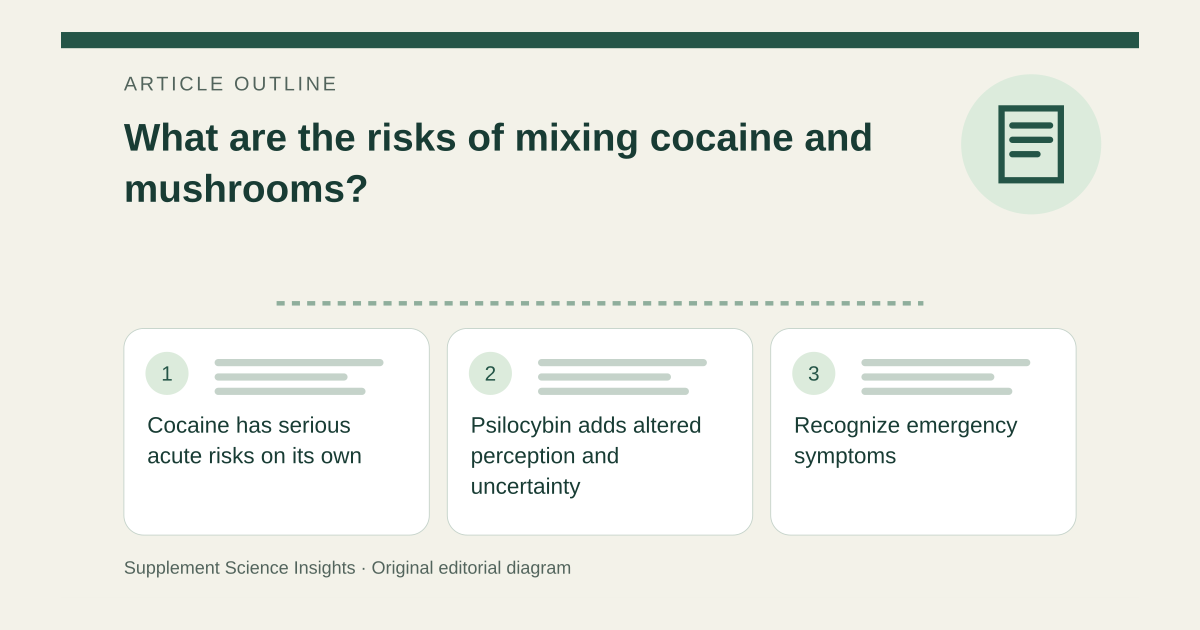
Cocaine has serious acute risks on its own
NIDA describes increased heart rate, blood pressure and temperature, as well as possible panic, paranoia, seizures, stroke and heart attack. Serious events can occur unexpectedly; a prior uneventful exposure does not establish safety. [1]
Psilocybin adds altered perception and uncertainty
Psilocybin can produce anxiety, confusion and cardiovascular changes. Available guidance does not establish a safe combined dose or a reliable sequence for using these drugs together. The magnitude of additional risk is not precisely quantified here. [2][3]
Recognize emergency symptoms
Chest pain, a seizure, collapse, marked confusion or breathing difficulty after this combination needs emergency assessment. Tell clinicians about all substances, including alcohol, prescribed medicines and any unknown products. [1][4]
One drug does not neutralize another
Imagine someone uses cocaine because mushrooms made them tired. Feeling more awake would not prove that perception, circulation or judgment are safe. Do not add further substances to counter the combination. [1][3]
| Claim | Why it fails |
|---|---|
| More alert means safer | Alertness is not cardiovascular safety |
| Prior tolerance | Does not predict the combination |
| Natural mushroom | Still pharmacologically active |
| Chest pain | Urgent assessment, not observation alone |
Sources for this article
- Cocaine | National Institute on Drug Abuse (NIDA)
Source consulted: 2026-09-21. This is a reference resource, not a claim that we conducted the studies or tested a product. - Psilocybin for Mental Health and Addiction: What You Need To Know | NCCIH
Source consulted: 2026-09-21. This is a reference resource, not a claim that we conducted the studies or tested a product. - Psychedelic and Dissociative Drugs | National Institute on Drug Abuse (NIDA)
Source consulted: 2026-09-21. This is a reference resource, not a claim that we conducted the studies or tested a product. - Poisoning first aid: MedlinePlus Medical Encyclopedia
Source consulted: 2026-09-21. This is a reference resource, not a claim that we conducted the studies or tested a product.