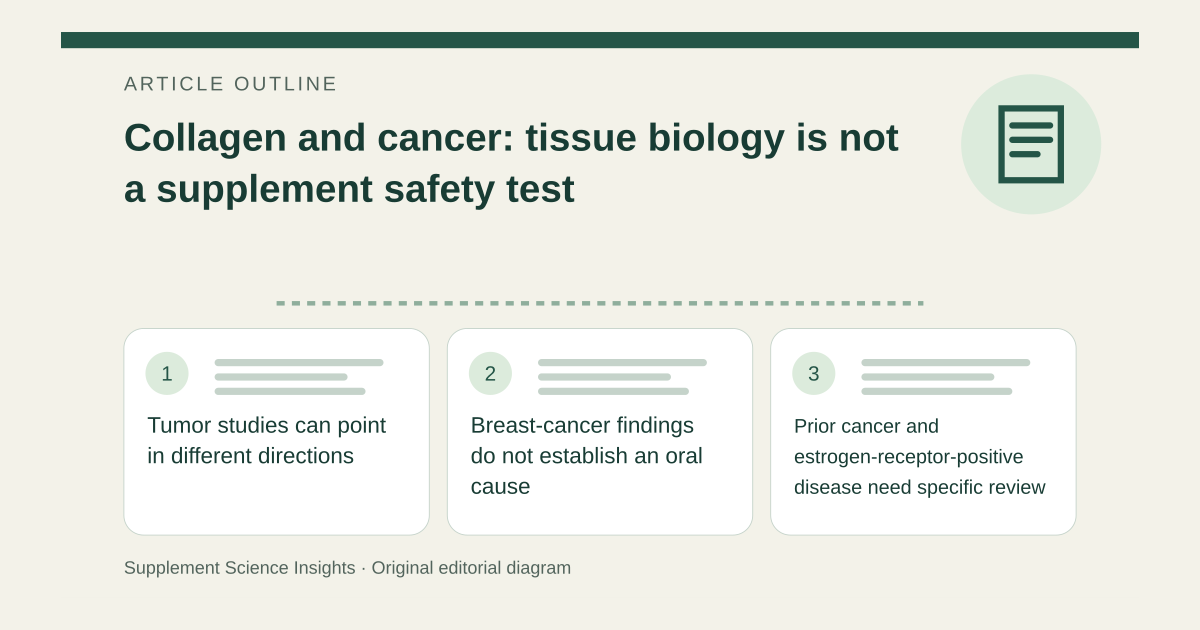
Tumor studies can point in different directions
MSK describes preclinical findings in which collagen supported tumor progression and others in which it had suppressive effects. These are context-dependent laboratory or model findings. They do not directly measure cancer incidence or recurrence in people taking a retail collagen powder. [1]
Breast-cancer findings do not establish an oral cause
A finding about collagen density or organization in breast tissue is not an intervention trial of oral supplementation. It cannot alone establish that a scoop raises breast-cancer risk. The opposite claim—that no such trial proves harm, therefore every supplement is safe—is also unwarranted. [1]
Prior cancer and estrogen-receptor-positive disease need specific review
The cited sources do not establish universal collagen-supplement safety for estrogen-receptor-positive breast cancer or for everyone who has completed treatment. Share the exact formula and treatment history with the oncology team. A blend can include additional vitamins or botanicals, so approval of one ingredient name does not assess the whole product. [2][3][4]
Do not use collagen to prevent recurrence or alter cancer treatment
NCI does not support supplements as a proven way to cure cancer or prevent its return. Its interaction guidance concerns supplements broadly; it should not be misreported as proof of a particular collagen-drug interaction. Continue the agreed treatment and nutrition plan while evaluating an optional product. [2][3]
Bring the product rather than a slogan
Imagine two survivors ask about collagen, but one powder is plain and another includes several herbs. Their formulas and treatment circumstances differ. An oncology review can assess the actual proposal; a headline about collagen in tumor tissue cannot perform that review. [2][4]
| Evidence | What remains unanswered |
|---|---|
| Tumor collagen model | Oral supplement effects in people |
| Product contains collagen | Safety of all added ingredients |
| No demonstrated recurrence benefit | Not a substitute for cancer care |
Sources for this article
- Collagen | Memorial Sloan Kettering Cancer Center
Source consulted: 2026-09-21. This is a reference resource, not a claim that we conducted the studies or tested a product. - Cancer Therapy Interactions With Foods and Dietary Supplements - NCI
Source consulted: 2026-09-21. This is a reference resource, not a claim that we conducted the studies or tested a product. - Diets, Supplements, and Cancer - NCI
Source consulted: 2026-09-21. This is a reference resource, not a claim that we conducted the studies or tested a product. - Dietary Supplements: What You Need to Know
Source consulted: 2026-09-21. This is a reference resource, not a claim that we conducted the studies or tested a product.