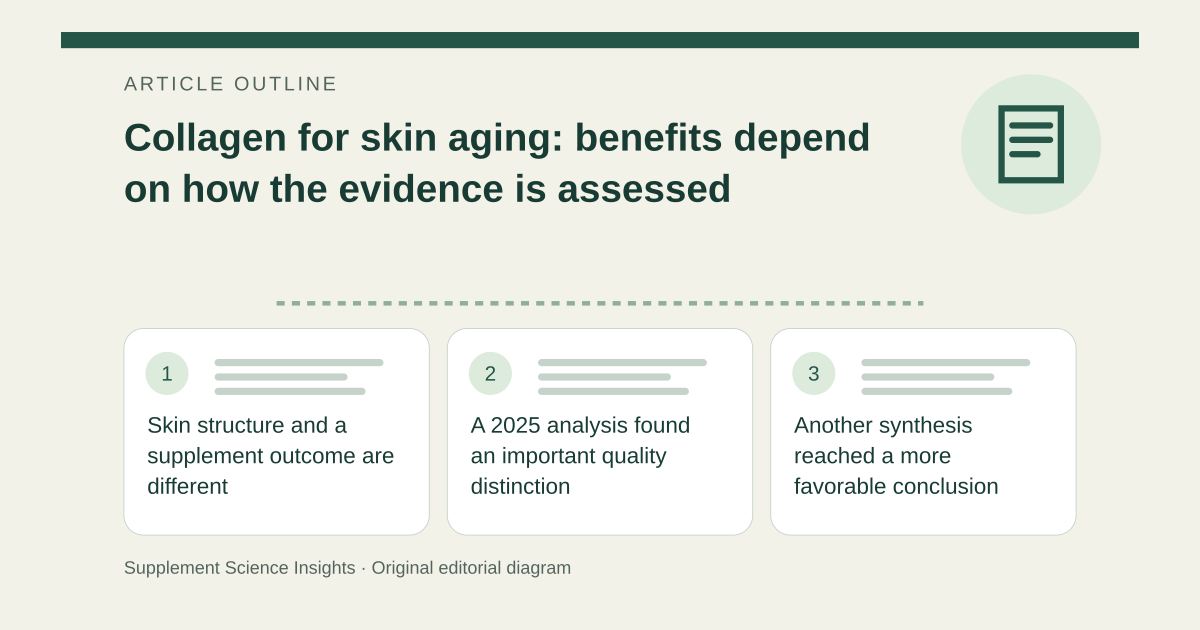
Skin structure and a supplement outcome are different
AAD describes collagen as a key structural protein and notes declining production with age alongside changes in elasticity and wrinkles. A supplement is a separate intervention. Calling a product type I, marine or bovine does not show that it reconstructs the face or supplies a measured amount of new skin collagen. [1][2]
A 2025 analysis found an important quality distinction
The inspected abstract reports 23 randomized trials with 1,474 participants. Overall pooling favored collagen for hydration, elasticity and wrinkles, but high-quality studies and studies without pharmaceutical-company funding did not show significant benefit in those categories. The authors reached a negative overall clinical recommendation. This reports the abstract; the full paper and every underlying trial were not independently appraised here. [3]
Another synthesis reached a more favorable conclusion
A 2026 umbrella review reported favorable skin findings, but rated only one of its 16 included meta-analyses high quality; four were low and eleven critically low. It also noted heterogeneous, often short studies and missing long-term clinical endpoints. Its authors reported no funding or conflicts. These differences argue against treating a pooled improvement as a universal product guarantee. [4]
Tightening and crepey skin need a defined outcome
A measurement of hydration or elasticity is not automatically a visible lift of loose skin. No universal best collagen type for tightening, facial use or crepey skin is established by these sources. Compare the actual formulation and outcome, and discuss persistent skin concerns with a dermatologist rather than escalating scoops in pursuit of a promised transformation. [3][4][5]
Make the uncertainty part of the decision
Imagine two products advertise different source animals and identical anti-aging promises. The source label alone cannot settle which works better. Consider dietary fit, full ingredients, cost and how a meaningful result would be assessed; do not treat a before-and-after photograph as a controlled comparison. [2][5]
| Claim | Required distinction |
|---|---|
| Improves hydration | Not necessarily a visible lift |
| Contains skin-associated collagen type | Not proof of targeted replacement |
| Supported by a meta-analysis | Check quality, funding and comparable preparations |
Do wrinkle findings demonstrate repair of sun damage?
Not by themselves. One placebo-controlled trial in 114 women aged 45–65 tested 2.5 g of a specific collagen-peptide preparation for eight weeks and reported changes in eye-wrinkle volume and selected skin-matrix markers. Those are the endpoints supporting its reported result. [6]
A smaller wrinkle measurement does not establish protection from ultraviolet exposure, reversal of UV-related DNA damage or prevention of skin cancer. The reported trial outcomes cannot support those broader claims, even if some participants had visible skin aging. Assess sun-damage and photoprotection claims using evidence that actually measures those outcomes rather than substituting a cosmetic endpoint. [6]
Sources for this article
- Supplement secrets unveiled: debunking common myths about beauty boosters
Source consulted: 2026-09-21. This is a reference resource, not a claim that we conducted the studies or tested a product. - Collagen Supplementation for Joint Health: The Link between Composition and Scientific Knowledge - PMC
Source consulted: 2026-09-21. This is a reference resource, not a claim that we conducted the studies or tested a product. - Effects of Collagen Supplements on Skin Aging: A Systematic Review and Meta-Analysis of Randomized Controlled Trials.
Source consulted: 2026-09-21. This is a reference resource, not a claim that we conducted the studies or tested a product. - Collagen Supplementation for Skin and Musculoskeletal Health: An Umbrella Review of Meta-Analyses on Elasticity, Hydration, and Structural Outcomes - PMC
Source consulted: 2026-09-21. This is a reference resource, not a claim that we conducted the studies or tested a product. - Should I take vitamins or supplements for my skin?
Source consulted: 2026-09-21. This is a reference resource, not a claim that we conducted the studies or tested a product. - Proksch et al. — Specific bioactive collagen peptides, eye wrinkles and dermal matrix synthesis
Source consulted: 2026-10-28. This is a reference resource, not a claim that we conducted the studies or tested a product.