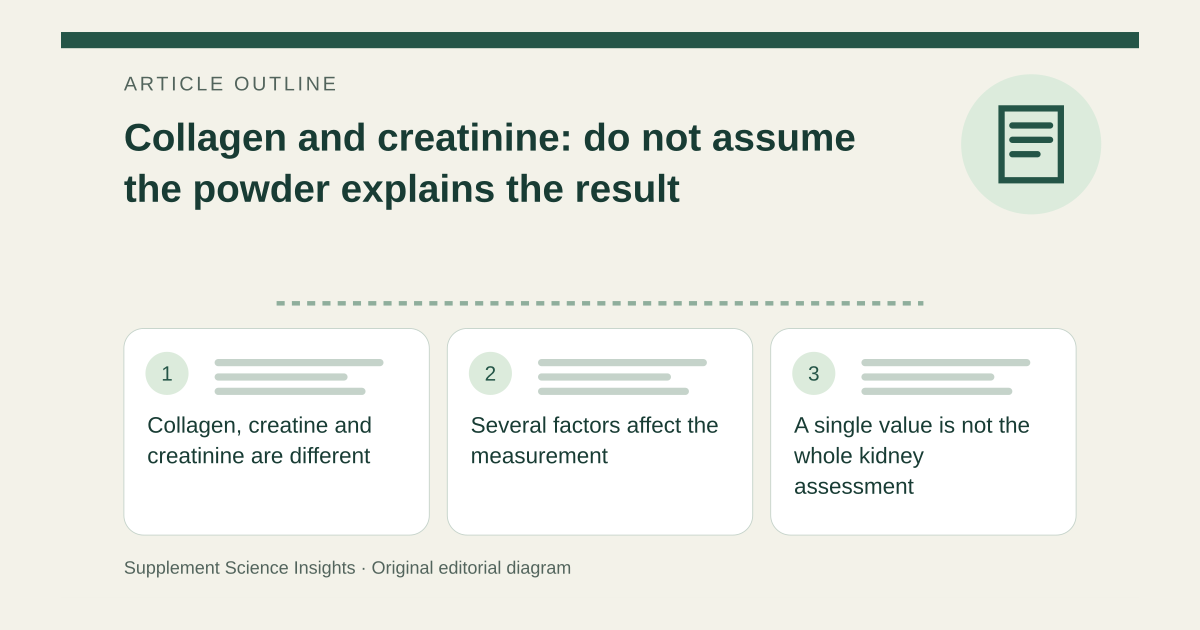
Collagen, creatine and creatinine are different
Collagen is a structural protein; creatinine is a waste product used in kidney assessment. NKF lists creatine supplements among factors that can raise creatinine independently of a change in filtration. That statement is about creatine and should not automatically be transferred to collagen because the names sound related. [1][2]
Several factors affect the measurement
MedlinePlus and NKF describe effects from muscle mass, intense exercise, dehydration, some medicines and cooked-meat intake. These factors do not prove that a particular collagen product caused a result. Check whether a blend also contains creatine or other ingredients and tell the testing team about them. [3][2][4]
A single value is not the whole kidney assessment
MedlinePlus notes that one high creatinine result cannot diagnose a specific condition. NKF explains that eGFR, trends and sometimes cystatin C provide additional context; combining creatinine and cystatin C can improve estimation. The clinician decides which follow-up fits the situation. [3][2]
Follow preparation instructions rather than manipulating the test
Some people are asked to avoid cooked meat or fast before testing; instructions depend on the test and clinical situation. Disclose supplements and ask whether to change them beforehand. Do not deliberately change intake to make a number look normal or stop prescribed medicine without advice. [3][2]
Review a new result with the full context
Imagine creatinine rises after starting a collagen-and-creatine workout blend and increasing hard training. Several explanations are possible, including kidney problems. Bring the label and timeline to the clinician, especially if there is existing kidney disease, instead of assigning the result to collagen by timing alone. [2][5]
| Detail | Why it matters |
|---|---|
| Full supplement formula | Collagen may not be the only ingredient |
| Recent exercise and diet | Can affect interpretation |
| Prior results and eGFR | Adds clinical context |
| New abnormal result | Needs appropriate follow-up |
Sources for this article
- Collagen | Memorial Sloan Kettering Cancer Center
Source consulted: 2026-09-21. This is a reference resource, not a claim that we conducted the studies or tested a product. - Creatinine | National Kidney Foundation
Source consulted: 2026-09-21. This is a reference resource, not a claim that we conducted the studies or tested a product. - Creatinine Test: MedlinePlus Medical Test
Source consulted: 2026-09-21. This is a reference resource, not a claim that we conducted the studies or tested a product. - Dietary Supplements: What You Need to Know
Source consulted: 2026-09-21. This is a reference resource, not a claim that we conducted the studies or tested a product. - “Kidney Detox” and Herbal Supplements: What’s Safe and What’s Not | National Kidney Foundation
Source consulted: 2026-09-21. This is a reference resource, not a claim that we conducted the studies or tested a product.