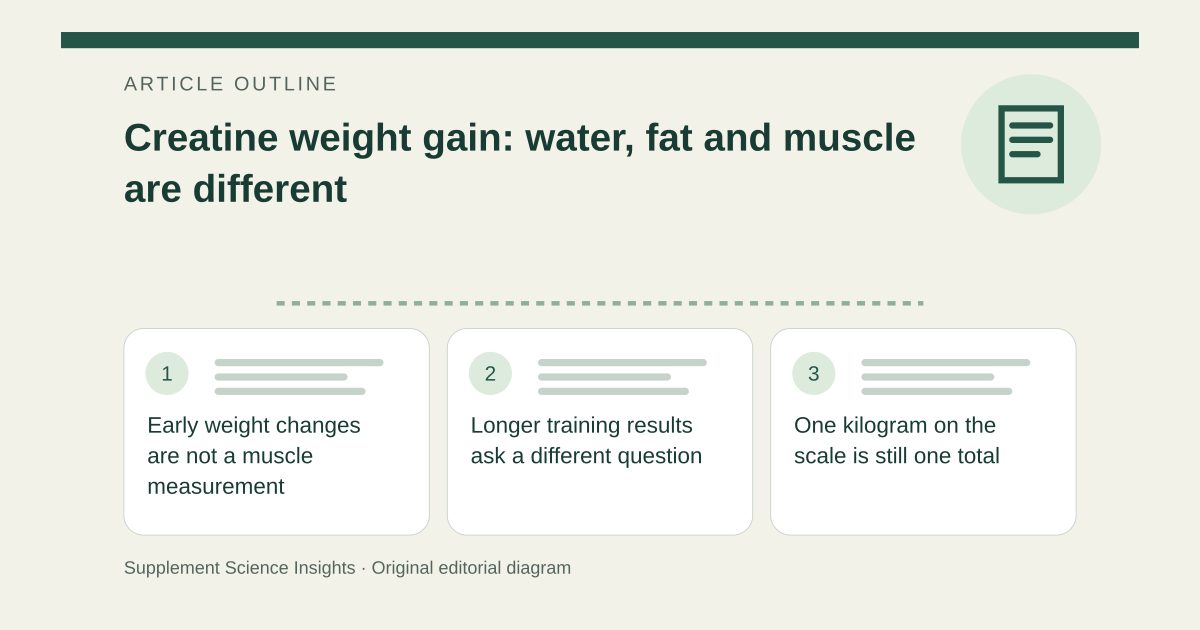
Early weight changes are not a muscle measurement
ODS reports that creatine often increases body weight, with water retention contributing. Creatine is osmotically active, and increasing its amount in muscle can affect water held there. [1][2]
A rapid increase on a scale therefore cannot be described as the same amount of newly built muscle. It is also not proof that creatine caused that amount of fat gain. A scale measures the total, rather than these components separately. [1][2]
Longer training results ask a different question
Creatine can help repeated high-intensity exercise and training adaptations. Changes occurring during weeks or months of resistance training can include muscle as well as water, but the proportions cannot be read from body weight alone. [1][2]
The 2021 review describes mixed findings for longer-term total body water relative to muscle mass. Early water retention should not be turned into a claim that every user develops persistent bloating or generalized fluid accumulation. [1][2]
One kilogram on the scale is still one total
Imagine an adult weighs one kilogram more shortly after starting creatine. Calling that kilogram all muscle, all fat or all retained water would each go beyond the measurement.
The timing, training history and method used to assess body composition matter. Comparing measurements under consistent conditions is more informative than assigning a tissue label to one weigh-in.
| Observation | Interpretation |
|---|---|
| Total weight increased | A total was measured |
| Muscle gain claimed | Requires more than that number |
| Sport has a weight constraint | The change may still matter |
Consider the demands of the sport
Additional weight may matter in weight-sensitive or endurance activities, even when it is not fat. ODS cautions that weight gain can impede some endurance performance. [1][2]
This explanation is not a diagnosis of unexplained swelling or rapid weight change. The water discussion is based on ODS and a 2021 review with disclosed industry relationships, not an individual fluid assessment. [1][2]
Sources for this article
- NIH ODS: Dietary Supplements for Exercise and Athletic Performance
Source consulted: 2026-09-17. This is a reference resource, not a claim that we conducted the studies or tested a product. - Antonio et al. (2021): Common questions and misconceptions about creatine supplementation
Source consulted: 2026-09-17. This is a reference resource, not a claim that we conducted the studies or tested a product.