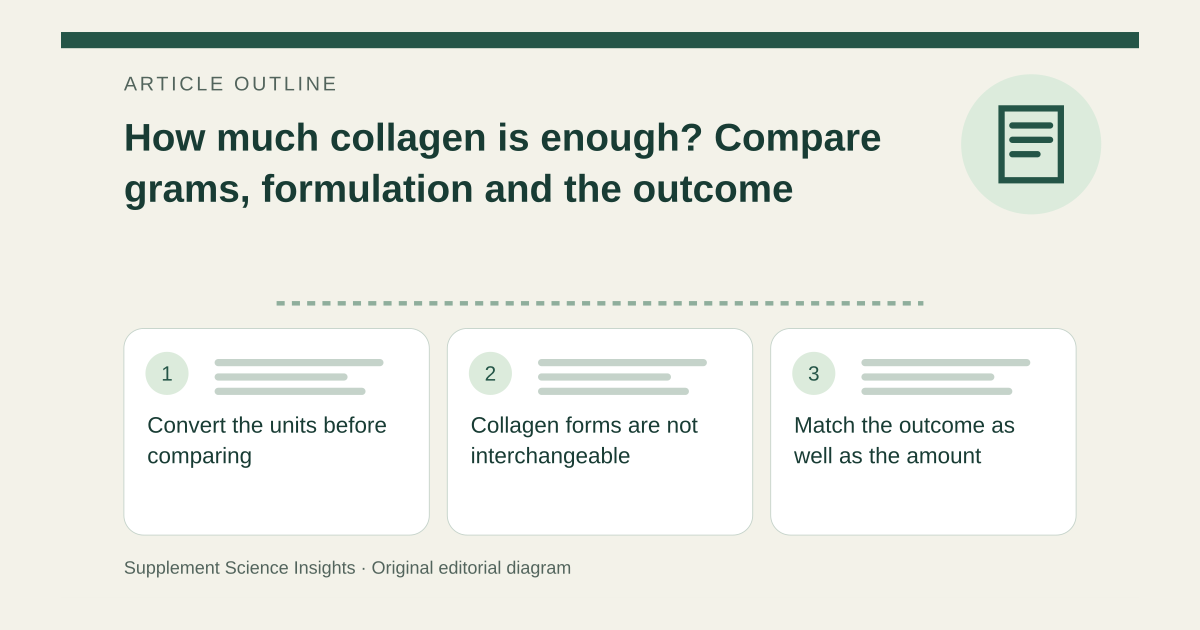
Convert the units before comparing
One gram equals 1,000 milligrams, so 100 mg is 0.1 g and 1,000 mg is 1 g. A 5 g serving contains half the mass of a 10 g serving, but that arithmetic does not establish half the benefit or identify the better treatment. [1]
Collagen forms are not interchangeable
The reviewed joint-health literature distinguishes hydrolyzed collagen peptides from native or undenatured type II collagen. Studies use very different amounts for these different preparations. A small native-type-II amount cannot be judged against a peptide-powder amount as though both were the same intervention. [2]
Match the outcome as well as the amount
Joint pain, joint structure and skin appearance are different endpoints. A dose table from joint research cannot establish an effective skin regimen, and a branded ingredient result does not validate every powder with the word collagen on it. This guide does not designate 100 mg, 1 g, 5 g or 10 g as universally sufficient. [2]
Read the complete daily serving
A scoop can contain flavoring or other ingredients in addition to collagen. Check the declared collagen amount and number of scoops per serving. Increasing servings also increases everything else in the formula; do not exceed directions merely to reproduce a number seen in a different study. [1][3]
Keep review limitations visible
The cited paper is a formulation-focused review rather than a head-to-head trial of all retail amounts. It reports no external research funding, while several authors disclose employment by a manufacturer of a native type II collagen ingredient. Those interests matter when interpreting its conclusions; this page uses it to distinguish preparations, not to endorse a product. [2]
Calculate a hypothetical serving correctly
Imagine a label supplies 10 g of collagen in two scoops. One scoop then supplies 5 g if measured as directed. That calculation identifies exposure; whether it offers a meaningful benefit still requires evidence matching the preparation and outcome. [1][3]
| Declared amount | Equivalent |
|---|---|
| 100 mg | 0.1 g |
| 1,000 mg | 1 g |
| Two equal scoops totaling 10 g | 5 g per scoop |
Sources for this article
- Questions and Answers on Dietary Supplements | FDA
Source consulted: 2026-09-21. This is a reference resource, not a claim that we conducted the studies or tested a product. - Collagen Supplementation for Joint Health: The Link between Composition and Scientific Knowledge - PMC
Source consulted: 2026-09-21. This is a reference resource, not a claim that we conducted the studies or tested a product. - How to Understand and Use the Nutrition Facts Label | FDA
Source consulted: 2026-09-21. This is a reference resource, not a claim that we conducted the studies or tested a product.