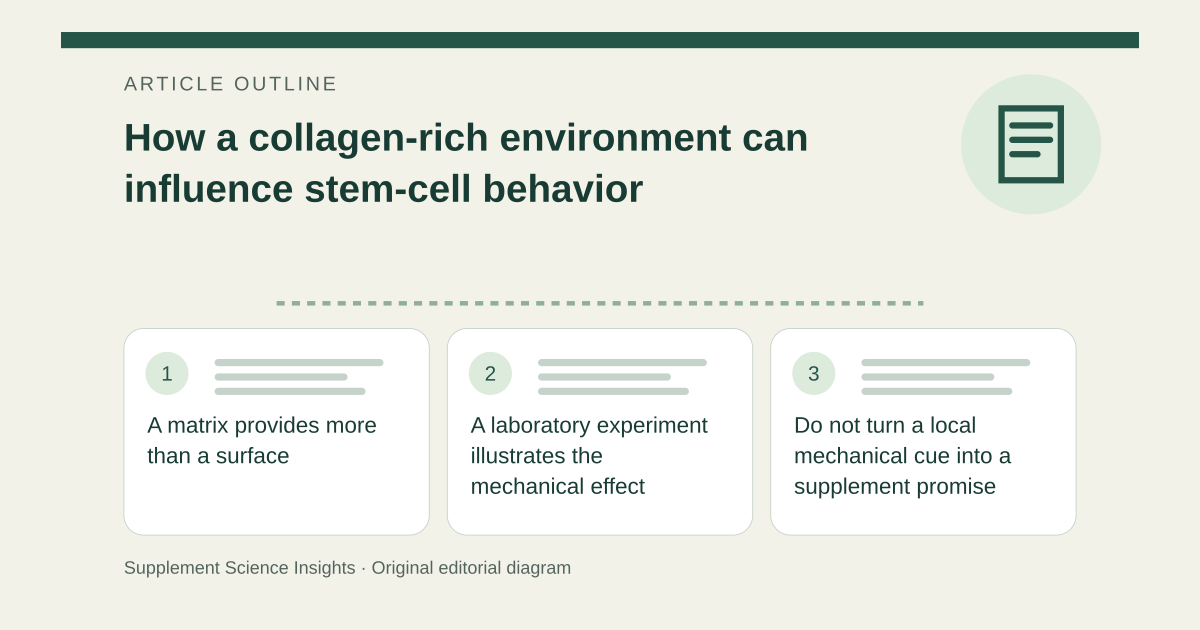
A matrix provides more than a surface
The extracellular matrix organizes the space around cells and provides connections through which cells interact with that space. Its composition and mechanical properties help shape the environment a cell experiences. Collagen is one part of that system, alongside other proteins, hydrated molecules and signals. [1]
A laboratory experiment illustrates the mechanical effect
A 2006 Cell study examined mesenchymal stem cells in culture on matrices with different elasticities. Its abstract reports lineage-associated behavior resembling nerve, muscle or bone cells under different mechanical conditions and an effect of inhibiting nonmuscle myosin II. This is an experimental cell-culture result, not a human treatment trial. The inspected abstract does not provide all replicate, funding or conflict details. [2]
Do not turn a local mechanical cue into a supplement promise
Imagine an advertisement cites matrix stiffness to claim that oral collagen activates stem-cell repair. The experiment changed the cells’ local substrate, not a person’s diet. A clinical claim would require evidence for that intervention, target tissue and patient outcome; the mechanobiology finding alone cannot provide it. [2][1]
| Observation | Interpretation |
|---|---|
| Cell-culture substrate | Controlled local environment |
| Lineage-associated markers | Not repaired human tissue |
| Oral supplement claim | A separate intervention requiring evidence |
Sources for this article
- The Extracellular Matrix of Animals - Molecular Biology of the Cell - NCBI Bookshelf
Source consulted: 2026-09-20. This is a reference resource, not a claim that we conducted the studies or tested a product. - Matrix elasticity directs stem cell lineage specification.
Source consulted: 2026-09-20. This is a reference resource, not a claim that we conducted the studies or tested a product.