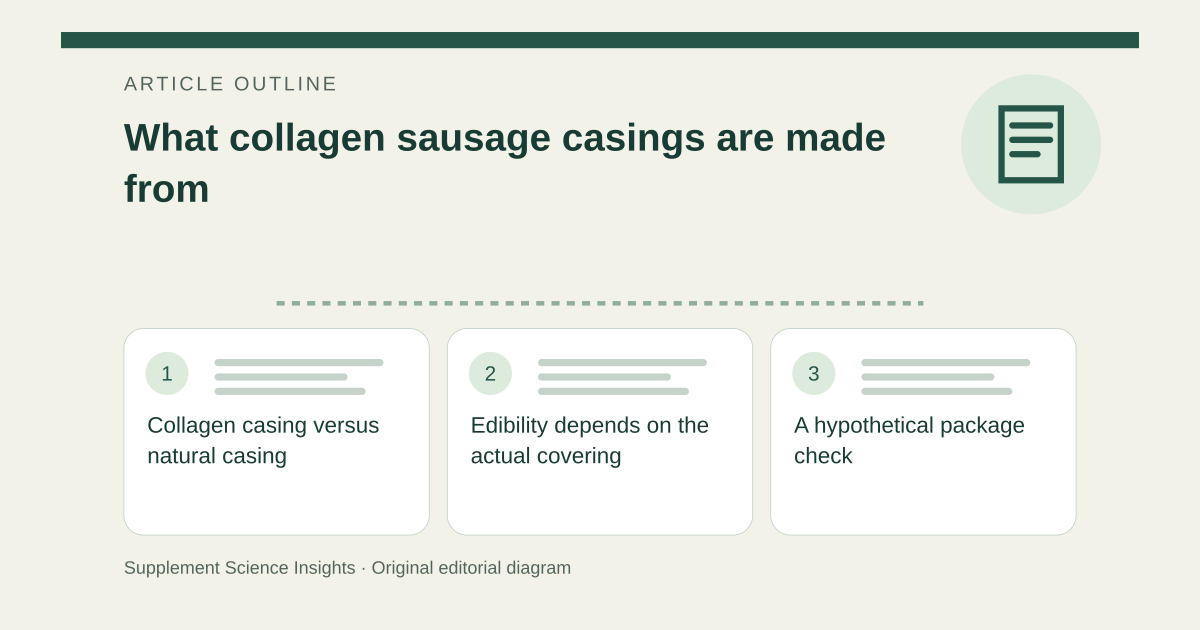
Collagen casing versus natural casing
USDA distinguishes natural casings made from animal intestines from collagen casings generally produced from animal hides. Both can be animal-derived, but they are not the same starting tissue or manufacturing category. [1][2]
A beef collagen casing identifies a bovine collagen source. That does not by itself identify the meat inside the sausage. Casing source and filling composition are two separate parts of the product. [1][2]
Edibility depends on the actual covering
Edible collagen casings are intended to be eaten with the product. Other sausage coverings, including some cellulose and plastic casings, are not edible. Follow the package's casing-removal directions; appearance alone is an unreliable guide. [1]
The fact that collagen is a protein does not justify treating every processed covering as food. The manufacturer's intended casing type and instructions are the practical distinction. [1]
A hypothetical package check
Imagine a sausage identifies an edible collagen casing and separately lists its meat ingredients. Read those as two pieces of composition information. If another package directs removal of its casing, follow that instruction rather than assuming the two coverings are equivalent because both look similar. [1][2]
| Question | Where to look |
|---|---|
| What is the casing made from? | Casing description |
| What meat is inside? | Ingredient list |
| Should the casing be removed? | Package directions |
Sources for this article
- USDA FSIS: What are casings made of?
Source consulted: 2026-09-20. This is a reference resource, not a claim that we conducted the studies or tested a product. - USDA FSIS: Collagen casing source labeling
Source consulted: 2026-09-20. This is a reference resource, not a claim that we conducted the studies or tested a product.