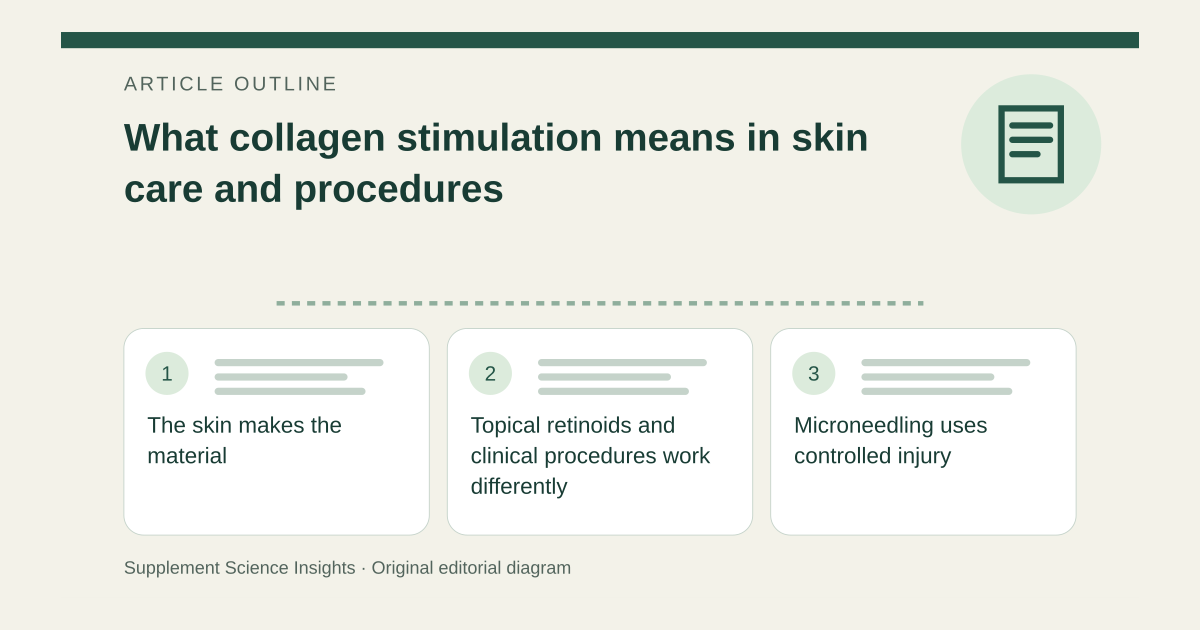
The skin makes the material
Collagen is assembled and organized by cells within connective tissue. Stimulation therefore differs from simply coating the surface with a collagen product. A treatment’s biological rationale still needs to be connected to a measured improvement that matters to the person receiving it. [1]
Topical retinoids and clinical procedures work differently
AAD describes retinoids as supporting collagen-related changes. It also describes professional ultrasound, radiofrequency and certain laser treatments that use controlled energy to provoke a tissue response. These methods are not interchangeable, and their effects are generally more limited than a surgical lift. [2][3]
Microneedling uses controlled injury
Medical microneedling creates small punctures that trigger a healing response; it is also called collagen induction therapy. The technique, device and patient selection matter. Home needling can cause infection, scarring or pigment changes, so a general explanation should not be treated as instructions for reproducing a medical procedure. [4]
An injection adds a material as well as a procedure
Some injectable products are discussed as collagen biostimulators, but the exact material and approved use must be established. Dermal fillers have distinct risks, including serious injury if inadvertently injected into a blood vessel. The word collagen does not make an injection equivalent to a moisturizing cream. [5]
Discuss outcome, recovery and risk together
Imagine a clinic advertises more collagen without specifying whether the goal is finer texture, reduced scars or lifting. Ask which treatment, what degree of change is realistic, how long it takes and what complications and recovery are possible. A biological claim alone does not answer those practical questions. [3][4]
| Claim | Follow-up question |
|---|---|
| Makes collagen | Which treatment and measured result? |
| No surgery | What risks and recovery remain? |
| Visible improvement | What magnitude and duration are realistic? |
Sources for this article
- The Extracellular Matrix of Animals - Molecular Biology of the Cell - NCBI Bookshelf
Source consulted: 2026-09-21. This is a reference resource, not a claim that we conducted the studies or tested a product. - Retinoid or retinol?
Source consulted: 2026-09-21. This is a reference resource, not a claim that we conducted the studies or tested a product. - Many ways to firm sagging skin
Source consulted: 2026-09-21. This is a reference resource, not a claim that we conducted the studies or tested a product. - Microneedling can fade scars, uneven skin tone, and more
Source consulted: 2026-09-21. This is a reference resource, not a claim that we conducted the studies or tested a product. - Dermal Filler Do's and Don'ts for Wrinkles, Lips and More | FDA
Source consulted: 2026-09-21. This is a reference resource, not a claim that we conducted the studies or tested a product.