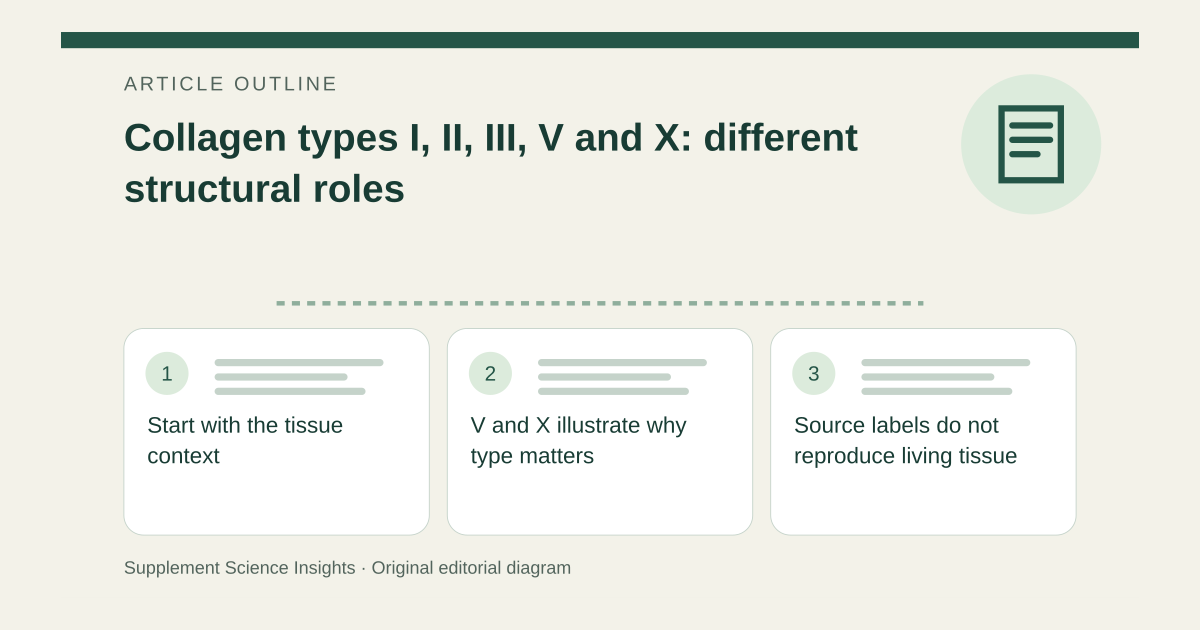
Start with the tissue context
Type I is a major fibrillar collagen of skin and bone, while type II is prominent in articular cartilage. Type III is another fibrillar collagen found in connective tissues. These proteins participate in organized tissue matrices rather than acting as interchangeable bags of structural material. [1][2]
V and X illustrate why type matters
Type V participates in fibril organization alongside other fibrillar collagens. Type X has a specialized role around hypertrophic cartilage cells in the growth plate and is structurally distinct from the main fibrillar types. Its higher numeral does not mean it is stronger or that consuming it increases adult height. [1][3]
Source labels do not reproduce living tissue
Imagine a powder advertises several collagen types. Processing may have hydrolyzed the source proteins into peptides, so the mixture is not intact cartilage or a growth plate. Compare the actual preparation and clinical evidence rather than assuming that more type numbers deliver more complete tissue repair. [4]
| Comparison | Distinction |
|---|---|
| I and II | Prominent in different tissue contexts |
| V and X | Distinct organization or developmental roles |
| Multi-type hydrolysate | Not replacement living tissue |
Can you identify the collagen type from the animal name?
Animal and tissue source are separate pieces of information. The source review describes type I collagen from bovine tissues and extraction of type I from porcine or fish skin. The undenatured type II preparation in the cited knee trial came from chicken sternum cartilage. These are specific material examples, not a rule that every ingredient from those animals contains only that type. [5][6]
An animal name alone does not verify a retail declaration of types I, II, III, V or X. Ask for the tissue source, preparation and material specification. Hydrolysis changes intact collagen into peptide mixtures, so a source-type label does not mean the swallowed product reproduces that tissue’s structure. The biological roles of types V and X do not identify a tested retail source or establish added benefit from including their numerals on a label. [5][6]
Sources for this article
- The Extracellular Matrix of Animals - Molecular Biology of the Cell - NCBI Bookshelf
Source consulted: 2026-09-20. This is a reference resource, not a claim that we conducted the studies or tested a product. - The Basic Science of Articular Cartilage: Structure, Composition, and Function - PMC
Source consulted: 2026-09-20. This is a reference resource, not a claim that we conducted the studies or tested a product. - Schmid Metaphyseal Chondrodysplasia - GeneReviews® - NCBI Bookshelf
Source consulted: 2026-09-20. This is a reference resource, not a claim that we conducted the studies or tested a product. - Collagen Supplementation for Joint Health: The Link between Composition and Scientific Knowledge - PMC
Source consulted: 2026-09-20. This is a reference resource, not a claim that we conducted the studies or tested a product. - León-López et al. — Hydrolyzed Collagen: Sources and Applications
Source consulted: 2026-10-28. This is a reference resource, not a claim that we conducted the studies or tested a product. - Lugo et al. — Undenatured type II collagen and knee osteoarthritis symptoms
Source consulted: 2026-10-28. This is a reference resource, not a claim that we conducted the studies or tested a product.