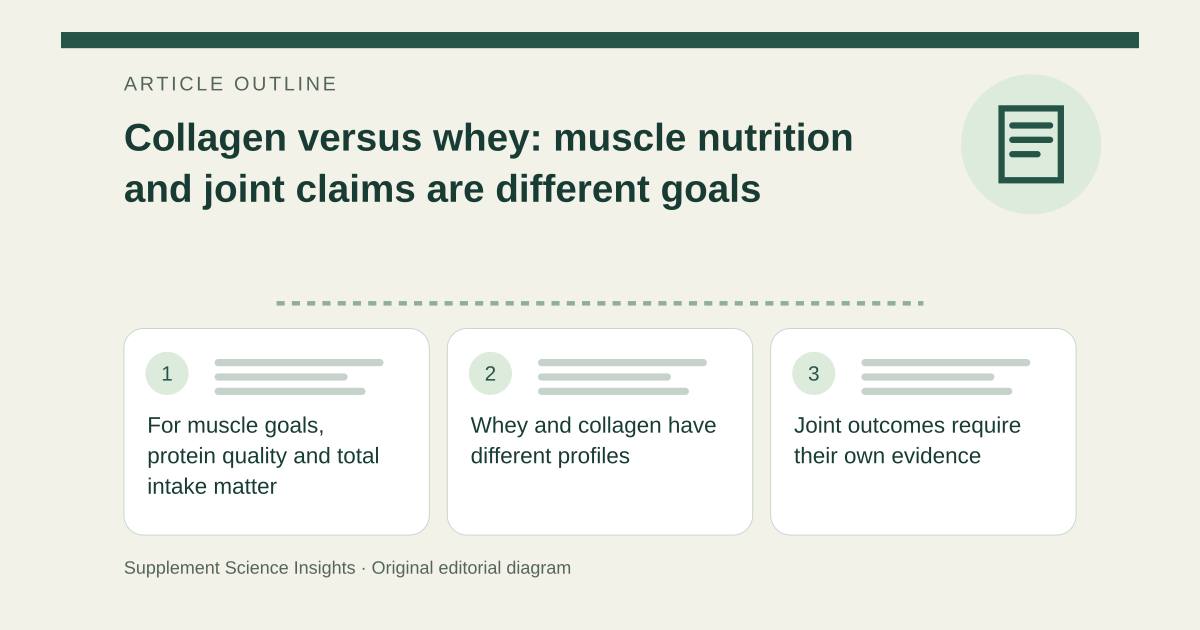
For muscle goals, protein quality and total intake matter
NIH ODS describes protein as supporting muscle repair and adaptation to exercise, with whey commonly used as a complete protein. Training, enough food and total daily protein remain central. A powder is useful when it helps meet a need; it is not required simply because someone exercises. [1]
Whey and collagen have different profiles
Whey is derived from milk, while collagen products commonly come from connective tissues and may be hydrolyzed into peptides. The same number of protein grams does not mean identical amino-acid composition or an identical research base. The National Dairy Council is an industry source for whey identity, not an independent reason to declare every whey product superior for every outcome. [2][3]
Joint outcomes require their own evidence
MSK describes low-quality evidence suggesting some collagen preparations may help osteoarthritis pain and function. That does not establish cartilage regrowth or make collagen a substitute for muscle-focused nutrition. Conversely, whey’s protein value does not establish it as an osteoarthritis medicine. [4][1]
Match the product to tolerance and diet
Whey is a milk-derived ingredient, which matters with milk allergy. Collagen’s animal source and other ingredients also need checking. People who avoid particular animal foods or need a specialized diet should choose a suitable way to meet protein needs rather than assuming one powder is mandatory. [5][2][3]
Choose by the problem you are trying to solve
Imagine someone wants more muscle from resistance training and also has knee pain. Review training and adequate high-quality protein for the muscle goal, and assess the knee separately. A combined product does not prove that both needs have been met or that two supplements are necessary. [1][6][4]
| Goal | Relevant consideration |
|---|---|
| Meet muscle protein needs | Adequacy, quality and training |
| Manage knee symptoms | Diagnosis and joint-specific evidence |
| Avoid an allergen | Actual source and full formula |
| Choose a powder | A way to meet a need, not a requirement |
Is collagen a complete protein?
Conventional hydrolyzed collagen is not a complete protein: it lacks tryptophan, one of the essential amino acids that must come from the diet. The cited protein-quality review also notes its low methionine content. Providing grams of collagen therefore is not the same nutritional proposition as providing the same grams of a protein with an adequate essential-amino-acid profile. [7]
That does not make collagen biologically useless or erase research on particular joint or skin outcomes. It means plain collagen should not be treated as a complete replacement for the broader protein sources in a diet. A blend that adds other proteins or amino acids needs its own composition assessment; its profile cannot be inferred from the word collagen. [7]
Sources for this article
- Dietary Supplements for Exercise and Athletic Performance - Health Professional Fact Sheet
Source consulted: 2026-09-21. This is a reference resource, not a claim that we conducted the studies or tested a product. - Whey vs. Casein Protein: Difference Explained | U.S. Dairy
Source consulted: 2026-09-21. This is a reference resource, not a claim that we conducted the studies or tested a product. - Collagen Supplementation for Joint Health: The Link between Composition and Scientific Knowledge - PMC
Source consulted: 2026-09-21. This is a reference resource, not a claim that we conducted the studies or tested a product. - Collagen | Memorial Sloan Kettering Cancer Center
Source consulted: 2026-09-21. This is a reference resource, not a claim that we conducted the studies or tested a product. - Food Allergies: What You Need to Know | FDA
Source consulted: 2026-09-21. This is a reference resource, not a claim that we conducted the studies or tested a product. - Osteoarthritis - Treatment and support - NHS
Source consulted: 2026-09-21. This is a reference resource, not a claim that we conducted the studies or tested a product. - Phillips — Current Concepts and Unresolved Questions in Dietary Protein Requirements and Supplements in Adults
Source consulted: 2026-10-28. This is a reference resource, not a claim that we conducted the studies or tested a product.