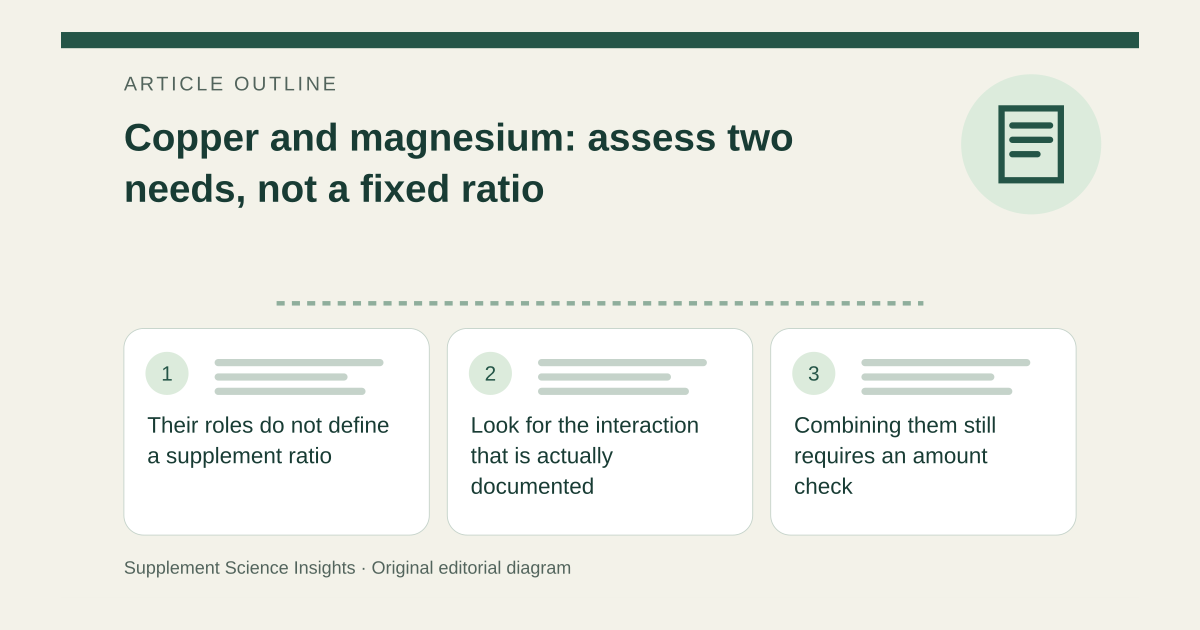
Their roles do not define a supplement ratio
Copper supports copper-dependent enzymes, while magnesium participates in many enzyme and physiological processes. These roles do not establish that taking one routinely depletes the other or that every user needs both in a fixed proportion. The cited ODS summaries do not provide a standard copper-to-magnesium dosing ratio. [1][2]
Look for the interaction that is actually documented
High zinc intake can impair copper status. That is a specific zinc-copper issue and should not be relabeled as a proven magnesium-copper effect. Review a multi’s full formula before attributing a low copper result to whichever mineral was most recently started. [1][3]
Combining them still requires an amount check
Imagine someone adds copper to compensate automatically for a magnesium capsule. That decision needs a reason beyond the pairing itself. Excess copper can cause harm, and magnesium supplements can cause gastrointestinal effects and become riskier with impaired kidney function. A clinician can assess suspected deficiency instead of relying on an invented balancing ratio. [1][2]
| Illustrative situation | Relevant distinction |
|---|---|
| Copper added because of magnesium | Need not established by the pairing |
| High zinc exposure | A documented copper-status concern |
| Renal impairment | Changes magnesium safety |
Sources for this article
- Copper - Health Professional Fact Sheet
Source consulted: 2026-09-20. This is a reference resource, not a claim that we conducted the studies or tested a product. - Magnesium - Health Professional Fact Sheet
Source consulted: 2026-09-20. This is a reference resource, not a claim that we conducted the studies or tested a product. - Zinc - Health Professional Fact Sheet
Source consulted: 2026-09-20. This is a reference resource, not a claim that we conducted the studies or tested a product.