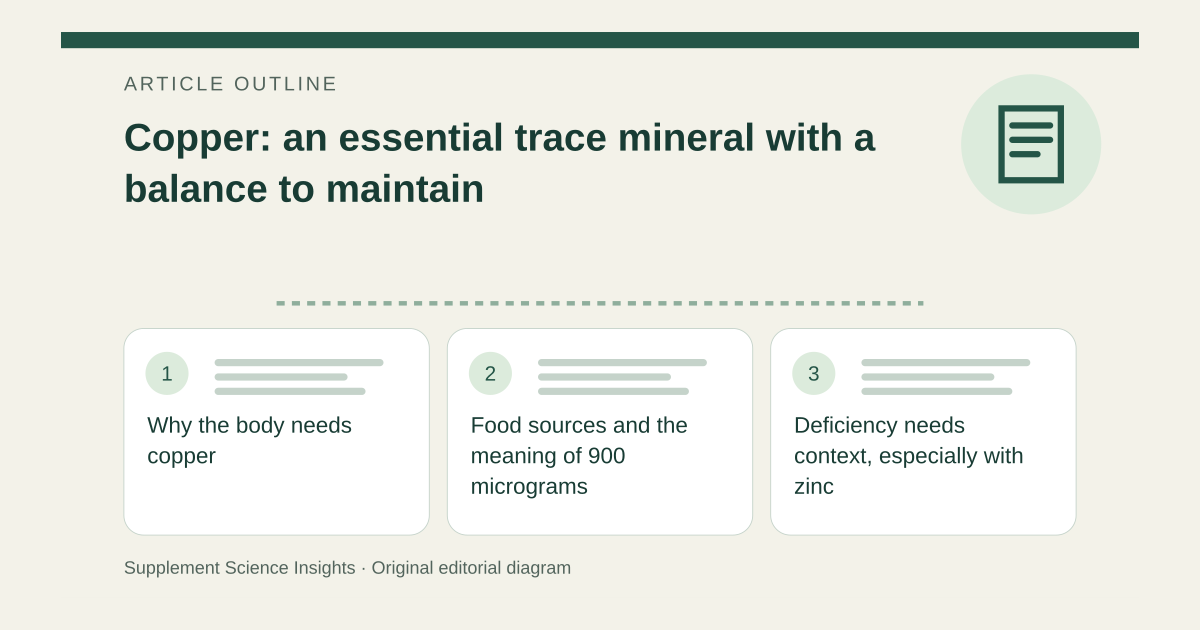
Why the body needs copper
Copper is needed in small amounts and must come from the diet. It works with iron in red-blood-cell formation and supports nerves, blood vessels, bones and immune function. Copper-containing enzymes also participate in energy production and connective-tissue formation. [2][1]
An essential role does not mean that more copper improves those functions. “Supports energy” can describe a nutrient’s normal biology without demonstrating that a supplement treats fatigue. Keep that distinction in mind when an ingredient’s many roles become a long list of promised benefits. [2][1]
Food sources and the meaning of 900 micrograms
Shellfish, nuts, beans, whole grains and organ meats supply copper; potatoes and cocoa contribute too. People commonly obtain enough through food. For adults aged 19 and older, the U.S. recommended dietary allowance is 900 mcg per day, equivalent to 0.9 mg. It rises to 1,000 mcg during pregnancy and 1,300 mcg during breastfeeding. [2]
These values describe total intake from the diet and supplements together. A supplement containing the full daily allowance is therefore not automatically the missing amount in someone’s diet. Start with the existing intake rather than treating the reference value as a default capsule dose. [2]
Deficiency needs context, especially with zinc
Copper deficiency is uncommon but can cause anemia and neurological problems. Malabsorption and excessive zinc use are relevant contexts. High zinc intake can interfere with copper absorption; adding a second mineral without examining the first supplement can miss the reason for the imbalance. [1]
Blood copper and ceruloplasmin results also need interpretation: inflammation, pregnancy and other factors can affect them. A symptom list or a single result does not establish a self-treatment plan. Bring the full supplement history, including zinc dose and duration, to the assessment. [1]
What a copper supplement has not established
NIH describes mixed observational findings linking copper measures with cardiovascular or cognitive outcomes. An association does not show that changing copper intake will prevent heart disease or dementia. Supplement decisions should not be based on the assumption that a higher blood level is necessarily better. [1]
Likewise, ingredient forms such as copper gluconate, sulfate or amino-acid chelates do not come with an established universal clinical ranking. NIH notes a lack of comparative bioavailability studies among supplemental forms. A premium-sounding form name cannot fill that evidence gap. [1]
Why Wilson disease is a different situation
Excess copper can be harmful even without an inherited disorder. It can cause gastrointestinal symptoms and liver damage; more is not automatically better because the required dietary amount is small. [3][1]
Wilson disease is an inherited disorder in which the body does not remove copper normally. Copper can accumulate in organs, including the liver and brain. It is not an ordinary dietary shortfall, and care aims to control copper rather than add it casually. [3][1]
NIDDK emphasizes diagnosis and continuing treatment because organ damage can develop. Anyone with known Wilson disease should use supplements only within their specialist’s plan. This exception illustrates why a nutrient can be essential in the general population and inappropriate as an added supplement for a particular person. [3][1]
Add overlapping products in one unit
Imagine a multivitamin declares 900 mcg copper per daily serving and a separate trace-mineral product declares 1 mg. Convert 900 mcg to 0.9 mg, then add: the fictional supplemental total is 1.9 mg. The table makes the overlap visible; it is not a recommended combination.
Food and any other copper sources are still outside that subtotal. If the second product gives only a total mineral-blend weight, the calculation cannot be completed. Mark its copper amount unknown instead of dividing the blend equally or assuming it contributes nothing.
| Entry | Printed amount | Amount in mg |
|---|---|---|
| Multivitamin | 900 mcg | 0.9 mg |
| Trace-mineral product | 1 mg | 1 mg |
| Supplement subtotal | 1,900 mcg | 1.9 mg |
A useful next step is a complete intake record
For a nutrition question, record copper-containing foods and supplements. For a possible deficiency question, include zinc use, relevant medical history and test results. For a product claim, ask what outcome was actually measured and whether the preparation matches the label.
These are different questions and may lead to different decisions. This overview uses authoritative reference summaries and does not diagnose a mineral imbalance or select a treatment dose. No retail product is recommended without a defined need and an exact, readable label.
Sources for this article
- NIH Office of Dietary Supplements — Copper: Health Professional Fact Sheet
Source consulted: 2026-09-17. This is a reference resource, not a claim that we conducted the studies or tested a product. - MedlinePlus Medical Encyclopedia — Copper in diet
Source consulted: 2026-09-17. This is a reference resource, not a claim that we conducted the studies or tested a product. - NIDDK — Definition and facts for Wilson disease
Source consulted: 2026-09-17. This is a reference resource, not a claim that we conducted the studies or tested a product.